

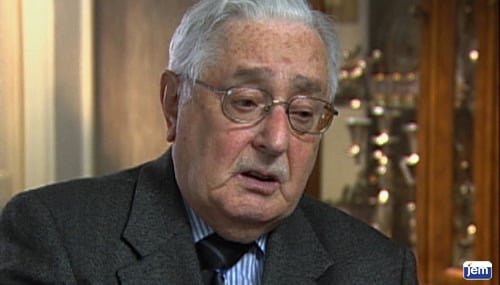
I first met the Rebbe when I visited him to discuss my mother’s illness.
I was not a chasid. In fact, I was educated in the Mesivta Chaim Berlin and I received rabbinic ordination from Rabbi Yitzchak Hutner. But when my mother fell ill, I went to the Rebbe because everyone among the Orthodox Jewish public already knew – it was in the public domain, so to speak – that to get good advice, to get a compassionate answer to a difficult question, to glimpse a solution to a complex dilemma, you went to the Rebbe, and that the Rebbe’s door was never closed to anyone.
My mother’s doctors could not agree on whether they should operate or not. An operation offered the possibility of a cure, but it carried a risk. Yet doing nothing meant that things would go on as they were, with the inevitable ending.
As a son, I was torn. And my mother, may she rest in peace, couldn’t make the decision. So I went to the Rebbe. I wanted to get his blessing and his advice.
Now, the Rebbe didn’t know me, didn’t know my mother, didn’t know anything about the family. But when I told him my dilemma, he looked at me and I saw tears in his eyes. He reacted as if he was my brother, and I felt as if I was discussing the problem with my brother.
His advice was that they should operate, but that’s not the point of the story. It was his reaction and his sensitivity that struck me. He had a holy look, such an air of compassion about him. I’d like to describe his expression and his intense blue eyes, but my words wouldn’t do justice. I felt an immediate heart connection – as they say, “words that come from the heart, enter the heart” – this was a man of truth, a man of G‑d.
Even if he had said nothing to me, I would have gone out with something, just having seen him.
Now, on this visit, I didn’t go representing Young Israel. I said nothing about being the chief executive officer of Young Israel – I was just a Jew asking for his blessing and advice for a personal reason. And for him to show such empathy, such emotion, such care, such concern … that, in itself, was remarkable.
It’s strange how he could relate to every individual, to every community, with the same intensity. I’m sure that decisions made on the world scene by the Rebbe were made by him with the same depth of understanding which he showed to every individual that came to see him about a minor issue, and with the same depth of caring that he showed me.
Which brings me to my second visit with him.
It was the early 1960s, and I had discovered that too many Orthodox men and women who were going to out-of-town colleges were dropping Yiddishkeit and intermarrying. At first the number was three percent, but this number was going up rapidly, and this alarmed me.
I called together the officers of Young Israel and I said, “We have a problem!” We agonized over it, and we decided to ask a number of Jewish leaders what to do.
I remember that one of them said we have to make sure that there are more Orthodox college professors. Well, that was not in our power. Another said that we have to make sure that the Jewish high schools imbue Yiddishkeit in their students so that they are able to withstand the pressures of college. How could we do that? Another said that we in Young Israel should issue a proclamation that nobody is allowed to go to an out-of-town college. But we did not have that kind of clout.
And then we went to the Rebbe. The Rebbe was the most fascinating of them all, because he had the ability to speak to the individual but consider the whole. He had the ability to look past the symptoms and go to the heart of the problem.
The Rebbe analyzed for us what was really happening here. He said, “In Berlin, if you were a religious Jew, or if you were a member of any other religion, you had to defend your religion; you had to be able to answer people who challenged you; you had to know the philosophy of your religion in order to defend it. But Americans are not interested in defending religious philosophies. They are more interested in consistency. If a person is religious consistently, the average American will respect him.”

“So, let’s look at what consistency means. A religious boy or girl goes to an out-of-town college, and says to the parents: ‘Don’t worry, I’ll observe Shabbos and I’ll keep kosher. I’ll have cottage cheese every day for lunch, I’ll have salad every day for dinner, and I’ll have corn flakes every day for breakfast … I’ll manage for four years.’ Maybe they mean it, maybe they don’t mean it. Let’s assume they mean it. But can they do it?”
“Imagine a young man sitting in a college dining room with his non-Jewish peers,” the Rebbe continued. “How long is he going to put on his yarmulke and eat cottage cheese every single day? And what is he going to do when a girl says to him, ‘Take a taste of my lunch, it’s delicious!’ How can he deny her? After a while, the peer group will pressure him – not because they mean to pressure, not because they are opposed to what he is doing, but because that’s just how life is. And in the liberal atmosphere of the college campus, how can he not yield to that pressure?”
And then the Rebbe gave us his advice: “What you have to do
is create a program to bring together all the young Jewish men and women in one
place at the most vulnerable time. That most vulnerable time is not in the
classroom when they are each interested in their own notes or their own marks,
but in the non-classroom area. The best thing is to establish kosher ‘dining
clubs’ on college campuses.”
This was his practical solution, and this was something we could, and did, do. Young Israel started kosher dining clubs, which were hugely successful. These clubs became places where Orthodox men and women could eat, meet and be friends with one another, and be protected from outside influences.
Of all the advice that we were given, the only one that we found practical was the Rebbe’s suggestion. And it worked.
Dedicated in honor of Miriam Mariasha by Shloma Yehuda and Shterna Sara Litzman










Start a Discussion