

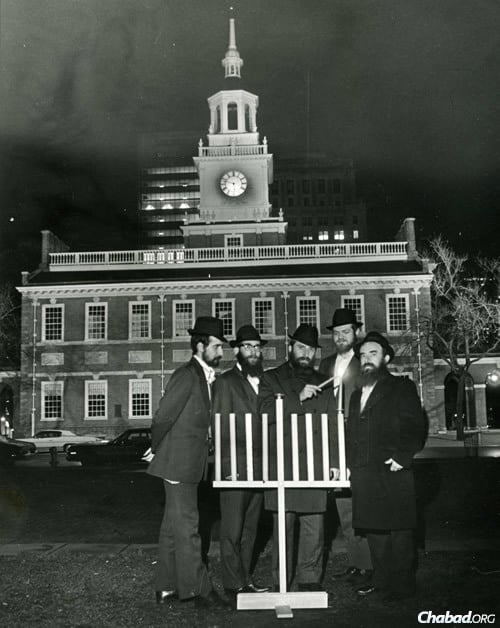
It was a frigid Saturday night during Chanukah of 1974, when Rabbi Abraham Shemtov had the unusual, perhaps wild, idea of lighting a menorah right in front of Independence Hall, which houses the Liberty Bell, the icon of American freedom.
The menorah was crude and made of wood; he had fashioned it with the help of some visiting yeshivah students. Almost no one was on Independence Mall in Philadelphia that night to witness the actual lighting, but that simple 4-foot menorah was the seed from which thousands of public menorahs have sprouted up on public and private places throughout the United States and around the world.
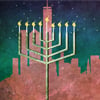
Fast-forward almost five decades, and more public memorahs than ever before will be light up the streets of cities, towns and villages around the world on the eight-day festival of Chanukah, which begins this year on Thursday eventing, Dec. 7, 2023 and runs through Friday, Dec. 15. These menorahs—many of which are set up and celebrated by Chabad-Lubavitch centers as part of Chanukah festivities—have become a staple of Jewish cultural and religious life in every corner of the globe. Jews from Moscow to Minnesota, from Monaco to Martinique, gather every year to celebrate the holiday with the lighting of an oversized menorah, usually 9-feet tall or more, and often towering above the celebrants.
But back in 1974, it was all just beginning.
The following year, Shemtov—regional director of Chabad-Lubavitch in Philadelphia and chairman of Agudas Chassidei Chabad, the umbrella organization of the Chabad-Lubavitch movement—returned with a more substantial menorah to light, as well as the permits necessary to do so.
Although he may not have known it at the time, exactly due west on the opposite U.S. coast, Chabad Rabbi Chaim Drizin in San Francisco had made arrangements to light an oversized wooden menorah in the city’s Union Square. Bill Graham—a child survivor of the Holocaust and a well-known music promoter—donated the construction of the 22–foot-tall mahogany menorah, and the tradition grew into its current form.
And one year earlier, on the corner of Fifth Avenue and 47th Street in Midtown Manhattan, a group of yeshivah students, led by Rabbi Shmuel Lipskier, lit a wooden ad hoc menorah mounted on top of a station wagon, the first car-top menorah in the world.
Over the next few years, menorahs began springing up in cities and towns all across America.
The next major development was in 1979, when Shemtov collaborated with Stuart Eizenstat—President Jimmy Carter’s chief domestic-policy adviser and executive director of the White House domestic-policy staff—to arrange for a menorah to be placed on the White House Lawn. Despite the fact that Carter was awash in the opening weeks of the Iranian hostage crisis, he pointedly walked from the White House to the menorah, where he lit the shamash—the helper candle from which the others are kindled—and shared greetings with the assembled crowd.
Perhaps reflecting his state of mind, the president voiced his dismay with the fact that only four candles were then lit—one flame is added every night for the duration of the eight-day holiday—as it signified a world still very much shrouded in darkness.

The 1980s: Growth and Challenge
Even as Jews everywhere flocked to public menorah-lightings in their cities and took pride in knowing that Chanukah was being celebrated in the public arena, the idea met with significant resistance—particularly from certain sectors of the “Jewish establishment” and from the ACLU, which claimed that it was a violation of the separation of church and state as mandated by the First Amendment.
Ironically, it was the same First Amendment that attorney Nathan Lewin would evoke time and time again as he successfully litigated dozens of cases in a decades-long effort to secure the right for Jewish people to place a menorah and observe Chanukah on public property.
In 1980, Rabbi Yisroel Brod, then director of Chabad Lubavitch of Bergen County, N.J., arranged for a large menorah to be set in front of the Bergen County Court House in Hackensack, N.J.

“It was beautiful,” recalls Brod. “It was an ideal location. Every night we would get hoisted up by a cherry picker to light the menorah. We had people from the Federation there, and everyone had a wonderful time.”
In advance of Chanukah 1981, Brod decided to erect a second menorah in his hometown of Teaneck, N.J., with its much larger Jewish population. “I was so naïve then; I had no idea that people would have an issue with it,” he relates. “So I was shocked when I got a calls asking that we not go ahead with it.”
In response to a letter from the Jewish Community Council of Teaneck, which opposed the menorah, the Rebbe—Rabbi Menachem M. Schneerson, of righteous memory—penned two letters in which he outlined his position on the matter.
“ . . . experience has shown,” the Rebbe wrote in his second letter, “that the Chanukah menorah displayed publicly during the eight days of Chanukah has been an inspiration to many, many Jews, and evoked in them a spirit of identity with their Jewish people and the Jewish way of life. To many others, it has brought a sense of pride in their Yiddishkeit and the realization that there is no reason really in this free country to hide one’s Jewishness, as if it were contrary or inimical to American life and culture. On the contrary, it is fully in keeping with the American national slogan ‘e pluribus unum’ and the fact that American culture has been enriched by the thriving ethnic cultures which contributed very much, each in its own way, to American life both materially and spiritually ... ”
Concerning the legality of placing a religious symbol on public grounds, the Rebbe cited precedence from the menorahs in major cities, as well as the menorah on the White House lawn. “That it was also constitutional, legal and proper goes without saying since the President of the U.S. personally participated in it,” he wrote.

Ultimately, Brod’s bid for a menorah that year was rejected by the Teaneck Township Council, and he decided not to pursue the matter.
He did arrange for a menorah to be lit for the first time in the New Jersey state capitol of Trenton. That tradition, which began in 1982, continues to this day.
By 1983, Brod’s empire of menorahs expanded to 15 stately structures standing proudly in front of town halls all across Bergen County (three municipalities—Fort Lee, Oakland and Hillside— put up their own).
The Rebbe’s letters proved to be invaluable for many emissaries facing similar issues.
A Little Help From New York
In 1981, Rabbi Yosef and Shiffy Landa, who had recently founded Chabad of Greater St. Louis the year before, decided to build a menorah on the large plaza adjacent to the St. Louis County Government Center. Working with a local fabricator, he built a 15-foot structure for $500. County executive Gene McNary attended the lighting ceremony, and the rabbi was gratified with the positive feedback he received.

When he began preparing for Chanukah the next year, like Brod, he “was surprised to learn how something positive like a menorah could evoke such negative responses” from within the Jewish community. Op-eds and letters flew fast and furiously. When articulating his position, he often used copies of the Rebbe’s letters to Teaneck.
Help came from an unexpected source: Ed Koch, the mayor of New York City. Speaking at a Jewish Federation event in St. Louis, Koch was asked how he would approach the issue. “I have no problem whatsoever with having a privately funded menorah on public property,” replied the Jewish mayor. “I think it’s absolutely wonderful. I’m proud to say that we have one in New York City at Fifth Avenue and Central Park.
“Let me tell you what else we do in New York,” he continued. “The menorah is in Manhattan. The people who light the menorah are the Lubavitchers. They live in Brooklyn. So when they light the menorah in Manhattan late on Friday afternoon when it’s getting close to Shabbos, we provide them with a helicopter and we fly them back to Brooklyn, so they can get home in time for Shabbos!”
After hearing all sides, McNary decided to keep the menorah on the plaza, and the tradition continued while he remained in office.
Back in Teaneck, the Township Council decided not to erect a menorah until a court ruling decided whether or not doing so was consistent with the U.S. Constitution.
That ruling would come on July 3, 1989, when the Supreme Court of the United States ruled (in a case known as County of Allegheny v. American Civil Liberties Union) that the city of Pittsburgh was allowed to place an oversized menorah lent to them by Chabad alongside a Christmas tree.

The case was argued by Lewin, who claimed that the Pittsburgh victory set an important precedent that has since been echoed in rulings all over the country.
Still, the fight was far from over. In fact, Lewin would need to litigate the same case the following year and even flew from Los Angeles to enter a last-minute application before Supreme Court Justice William Brennan on Friday afternoon just before Chanukah.
On a national scale, Lewin explains that the Pittsburgh decision only meant that a government body had the right to display a menorah on public property right next to other holiday displays.
It would take until 1993 (as part of a court case known as Flamer v. White Plains) to establish that individuals and groups have the right to put up such displays. That year, Sonia Sotomayor, the newly elected U.S. District Court for the Southern District of New York—who went on to be appointed to the U.S. Supreme Court in 2009—ruled that “the City may not deny Rabbi Flamer a permit to erect a fixed free-standing menorah in a City park during the Chanukah holiday because of the menorah’s religious message.”
In the course of court battle over the rights to place a menorah in Cincinnati’s Fountain Square, Lewin spent the entire Thanksgiving day of 2002 preparing arguments to be presented to Supreme Court Justice John Paul Stevens, who allowed the menorah to be put up “given the square’s historic character as a public forum.”
Many other significant victories were won in cities like Atlanta and Grand Rapids, Mich., each one establishing important precedent that would pave the way for future menorahs.
Today,” Lewin says, “when a community has an issue, our office sends a packet explaining the issues and the previous court rulings, and that is often enough to settle the issue favorably.”
A case in point would be Hamilton, N.J., where Rabbi Yaakov and Chana Chaiton just established a Chabad center this past July for the townships of Robbinsville and Hamilton, N.J.
“We approached the township with the idea of holding a menorah-lighting ceremony which would be the first ever in Hamilton, and they were considering,” says Chana Chaiton. “My husband had an afternoon meeting with the council, and we felt we needed some reassurance. I called Mr. Lewin’s office and was so touched by the attention he gave our situation. I’m sure he had a thousand important cases to attend to, but he personally took our specific needs into account and within an hour or two, he put together all the background information we would need to present the issue, and the council agreed to host the ceremony.”
She also notes that a neighboring Chabad center had a protracted battle to erect a public menorah, and Lewin had dedicated much time to help them reach a satisfactory conclusion.
“Chabad all over the U.S.—and indeed anyone who values our freedom to express our religious ideals—owes a deep debt of gratitude to those who have paved, and continue to pave, the way for this precious avenue of celebration,” she says.
For his part, Lewin says he’s still busy in the weeks and days ahead of Chanukah, as he continues to safeguard the right to erect menorahs on public property and still litigates the issue when necessary.
‘Let There Be Light’
With the legal issues largely moot, menorahs continue to crop up all over the country.
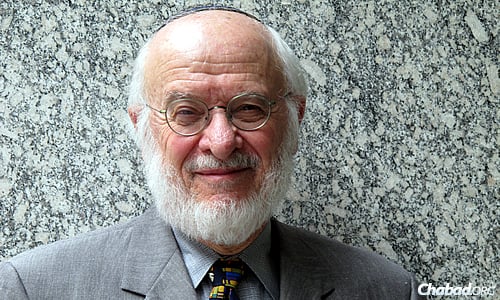
“It is not just the custom here, but now in other countries as well,” says Rabbi Yehuda Krinsky, chairman of Merkos L’Inyonei Chinuch, the educational arm of the Chabad-Lubavitch movement, who regularly monitored the developments and reported them to the Rebbe. “From Berlin to London to Melbourne, public menorahs are almost a routine thing. It’s a beautiful display of Jewish pride and does a lot of good.
“It seems Chanukah is the most observed of the seven rabbinic mitzvahs,” he continues, “and it’s singularly because of the Rebbe’s insistence and perseverance that celebrating Chanukah in the public sphere became popular.”
At the Rebbe’s behest, following Chanukah 1985, Krinsky’s office compiled a book chronicling public menorah-lightings around the world. Titled Let There Be Light, it contains photographs of menorahs from Alabama to Australia.
The many menorahs at state, city and county municipal centers demonstrated how widely accepted the menorah had become in Jewish life.
The following year, a sequel called . . . And There Was Light graphically depicted how much more extensive the celebrations were during Chanukah of 1986, which went into the new year of 1987. Among its many photographs is a delegation from American Friends of Lubavitch presenting a silver menorah to President Ronald Reagan in the Oval Office, a tradition that began in 1984.

Modern Markers of History
Throughout the following decades, the number of menorah and scope of their reach has continued to blossom. Last Chanukah, it was estimated that as many as 15,000 Chabad-Lubavitch menorahs were publically lit worldwide.
One of the largest lightings is the one near the Eiffel Tower in central Paris, which has attracted as many as 20,000 French Jews. Starting in 1989, the lighting was part of the “Chanukah Live” satellite hookup, in which the Rebbe would participate in a simultaneous celebration with communities from Moscow to Melbourne.
And in 1991, in the presence of approximately 6,000 Jewish people, longtime Chabad underground activist Avraham Genin kindled a giant menorah inside the Kremlin Palace of Congresses (it was the second year that a large public menorah had been lit in the U.S.S.R.; the previous year, a menorah had been placed near Russia’s White House).
Like before, the celebration was broadcast live.

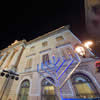
A new menorah—more than 30 feet tall, the highest in Europe—was constructed last year and lit on the first night of Chanukah at the Brandenburg Gate in Berlin, Germany, once the site of Nazi Party spectacles of racism and hatred, and a place that was inaccessible during the years of communist rule in East Germany.
Thousands of people attended the public ceremony, as did local dignitaries, including the president of the German parliament, Norbert Lammert, and Berlin’s mayor, Klaus Wowereit.
“Bringing light to places of darkness is the message of Chanukah,” said Chabad-Lubavitch of Berlin’s director, Rabbi Yehuda Teichtal. “There is no greater contrast than lighting a menorah here—in the place that was once the epitome of darkness—and now flooding it with the essence of light.”
Also last year, a 9-foot-high menorah was lit on the Gallaudet University campus in Washington, D.C., a federally chartered private university for the education of deaf and hard-of-hearing students.
“There was a wonderful spirit of inclusion and pride there, as the deaf community joined together with our hearing brothers and sisters around the globe in publicly celebrating our Jewish heritage,” says Rabbi Yehoshua Soudakoff, a Chabad rabbi who lit the menorah with the assistance of Gallaudet President Dr. T. Alan Hurwitz and Provost Dr. Stephen F. Weiner.
“The menorah really touches people,” asserts Rabbi Menachem Evers, who organizes the annual public lighting in Dam Square in front of the royal palace in Amsterdam, Holland. “I can recall an elderly lady who came to me with tears in her eyes, saying 60 years ago, she never dreamed she would live to see Jews proudly celebrating in the streets.”
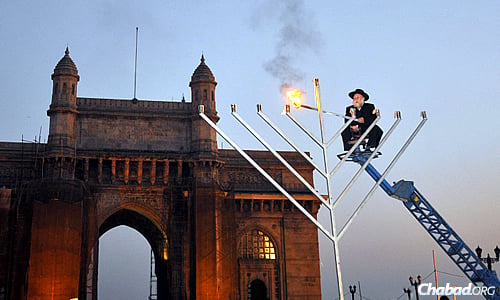
In addition to the great outdoors, another popular venue for public menorahs are indoor shopping mall, where across the world, Chanukah menorah-lighting celebrations have become de rigueur.
This has come about in part because of a decision by the Westfield Group—which owns about 100 shopping malls in Australia, New Zealand, the United States and the United Kingdom—to partner with local Jewish communities, hosting and even covering the expense of these celebrations as part of its operating budget.
And the celebration is echoed in cities and towns, on military bases, in hospitals and nursing homes, even in prisons, and just about any other place where Jews can be found—a roaring fire of Jewish pride, kindled from a few flickering flames on one cold night back in Philadelphia.




Join the Discussion