

This is the second of two articles on Chabad early-childhood education programs.
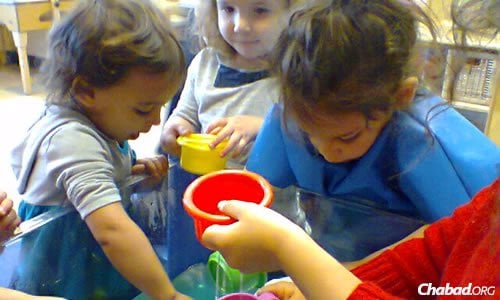
Rivka Goldschmidt started the Gan Menachem preschool in Dallas five years ago because she wanted a school for her own young children “where Judaism was integrated and woven through the whole early-childhood experience, where Judaism is not a subject that’s taught, but where everything is based on Yiddishkeit.”
There were six kids in that first class, and the school has since grown to 27 students between the ages of 2 and 5, almost the maximum number of 30 children Goldschmidt can legally have in her school.
For some of her students, Goldschmidt says, Gan Menachem may be the only formal Jewish education they receive: “With Jewish day schools costing so much money, parents want them to have this background as they move into their lives.”
That reality, educators say, is why it’s even more imperative to provide a solid foundation in secular subjects, in addition to all of the Jewish material. To that end, Goldschmidt’s own curriculum, like many of her contemporaries, includes art, music and reading—“we cover a broad range of topics.”
And the benefits seem to have paid off. Paula Winslow, a kindergarten teacher at Akiba Academy of Dallas and an early-childhood educator for many years, says the kids who come to her from Gan Menachem have “really great kindergarten-readiness skills.”
“They have a better attention span, can follow multi-step directions, have great phonemic awareness and, at that point, we can take off with [teaching] reading to those kids,” says Winslow. “They also have a good sense of writing letters and numbers.”
Competing With the Best
In the uber-competitive private-school environment of New York City, creating a strong program means not only competing with secular schools, but making sure that students from her preschool can transition to any “ongoing school,” says Sarah Rotenstreich, director of Preschool of the Arts.

“When we started the school 14 years ago, we had one vision—that parents would never have to choose between sending their children to a school with a stellar education [versus] their belief in Jewish education. Our goal was to combine the two, so that parents would enroll in our school and know they were getting the best of both worlds,” she says. “In addition, they know that by choosing our school, the ability to get into the best private schools is still there.”
The school has such a strong reputation in the general early-childhood community that Rotenstreich created the Global Educator Initiative, which allows educators from around the world to come, observe and learn from the teachers at Preschool of the Arts. The most recent participants came from China.
And it’s also quite popular among parents.
Currently, Preschool of the Arts operates three locations in Lower Manhattan, each with a unique flavor: one offers a Jewish library that’s open to the public; another features an art gallery where artwork by children and professional artists can be seen; and a third uses inspiration from New York’s Cooper Union College for its design. A fourth branch, for infants and toddlers, is slated to open in February. Even with the expansions, Rotenstreich reports that she has a waiting list of prospective students.
Likewise, the Chai Preschool in Foster City, Calif., isn’t able to offer slots to all the children who want to attend, according to school director Esty Marcus. The school opened in Marcus’s home nine years ago with just 12 kids and blossomed.
“We’ve now expanded it to 60 students,” she says, “and we still have 20 kids on the waiting list.”
That probably isn’t surprising given how much work Marcus has put into making sure her program is the best it can be, including consulting with the Stanford University-run Bing Nursery School—an educational research institute known for its famous “marshmallow study,” which examined kids’ impulse control.

“I had really wanted to work with them, but they hadn’t consulted with other schools that we knew of,” she says. Then, she had a chance encounter with Beverley Hartman, an associate director at the preschool. According to Marcus, Hartman was pleased to find that the Chai Preschool focused on what the Bing School values: community, respect and the importance of relationships. And so, she began consulting with the school.
Hartman’s feedback and ideas, Marcus says, “really changed our school.” These days, the Chabad educator passes the favor forward by consulting for other preschools.
Bang for the Buck
If the need for quality Jewish preschools that offer both religion- and secular-based educational components is out there, the costs of establishing such an institution are challenging. Some estimate the cost of starting a quality early-childhood program to be close to $100,000—for building costs, curriculum and staff development, materials and more—though certainly, many start with much less. But even $20,000 to $30,000 is a significant sum.
How then did Chabad emissaries open so many early-childhood programs in such a short amount of time?
Part of it was ingenuity on behalf of the shluchim, who believed in the importance of reaching out to young children and their families right away, and made that sentiment known to their communities. Others have benefited from local donors who shared a belief in Jewish education.
But it was the Machne Israel Development Fund, Early Childhood Initiative—which received a $5 million pledge from philanthropists David and Lara Slager of Manhattan—that in the last three years really sparked the rapid expansion of Chabad-run preschools. To qualify for funding, would-be educators had to prove that they had done their research and were prepared to open quality programs. That meant they needed to have detailed operational plans in place, along with a demographic study that showed a need for a preschool in their community.
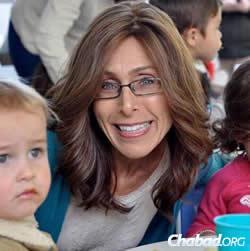
“We want to know that they’ve done their work,” says Batya Lisker, project administrator for the initiative. “It’s not enough to think that a program can succeed; rather, that they did the work and are realistic, and know what they are dealing with and where they want to go. Their passion needs to be tangible when applying for a grant.”
Some 50 schools have received grants from the fund ranging from $7,500 for a small “Mommy & Me” program to $100,000 for a larger preschool program. While some of the funding was seed money for new schools—such as those in Vail, Colo., and Yorba Linda, Calif.—several of the grants went to already established programs to help them expand their offerings to better serve their constituents.
“Our perspective is that the challenge to Jewish continuity can be solved with a Chabad-preschool experience,” says Lisker. She points to “anecdotal evidence” that shows those who have attended Chabad preschools as youngsters grow up to become active participates in the Jewish community. “Whether it’s supporting Jewish causes or joining a shul or enrolling their own children in Jewish programs,” Lisker says, “ … the Jewish awareness they’ve acquired stays in their hearts and doesn’t just impact them as a child, but in their future as well.”
Having a Chabad-run early-childhood center in a community does more than just mold the minds and bodies of the Jewish youth there, it also builds bridges to local families—a key component in making the schools a success. To that end, many of the schools offer programs for families as well—from holiday parties to group picnics to, in some cases, an actual kosher cafe where parents can spend time with fellow parents.
Classes specifically for the parents are also on the schedule at some schools. For instance, Chai Preschool offers a range of classes—during both daytime and evening hours—that include general parenting workshops and more specific sessions on Shabbat and holidays, challah-baking and more.
“The Jewish classes explain the ‘how to,’ as many of our parents want to know what to do, and also a little about why we have the particular custom or tradition,” says Marcus.
“As you start with young families,” says Rotenstreich, “they learn along with the children.” When the kids come home talking about holidays and Shabbat, the parents start asking questions and then “incorporate things [into their lives] that they feel connected to.”
“The preschool is, literally, the best way to reach out to young families because when they come to town, the No. 1 thing they are looking for is a preschool,” says Rabbi Yosef Greenberg, the Chabad shaliach in Anchorage, Alaska, whose wife, Esty, runs the Gan Yeladim Preschool & Early Learning Center. “And if by sending them to a preschool they see that Judaism gives them love, warmth and a sense of family, they will go for it for the rest of their lives.”
Inspiration Becomes a Lifestyle
Living a religious life was not what Allison Meshwork and her husband, Jason, had planned for when they enrolled their oldest of their four children, Levi, in a Chabad preschool in Toronto. The young, unaffiliated Canadian mother was just looking for a good program, and her friends had recommended the school—Torah Tots Preschool at Chabad of Markham—to her. “It seemed like a nice environment … and I thought it’s a Jewish place, we’re Jewish, and it looks like a good first place to go outside of the home without Mom.
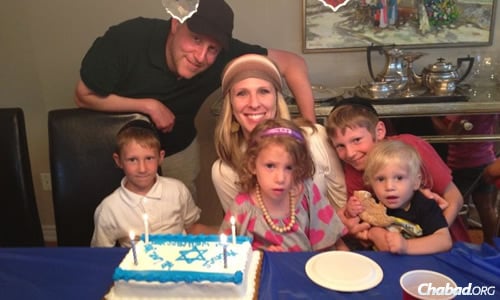
“The only thing that may have concerned me a bit—but it was a fleeting thing—was that we weren’t religious at all, and I wasn’t sure what Levi would be learning and how that would impact what we did at home.”
Then the Meshworks hit a crossroads. Levi, says his mother, “would come home very motivated, happy and excited. It was inspiring to us.”
At that point, they realized they had three choices: The first was to pull their son out of a school he loved because, as Meshwork explains, “he would be disappointed by the things we don’t do that he’s learning about, like Shabbat and holidays, but that didn’t feel right.” The next option was to tell her young son that what he learned at school was fine for school, but not practiced at home. “I probably felt worse about that,” she says, “because what’s the point of sending him to the school if he’s not going to do anything?”
The final option, which the Meshworks ultimately chose, was to “go with it” and make some changes at home.
From there, their exploration of Judaism grew and grew. Today, the family lives an Orthodox, but not Chabad, lifestyle. In fact, they made aliyah in July and live in Israel. They also all now use their Hebrew names.
Reflecting back on all the changes, Meshwork says: “I wonder where we would be if we hadn’t embraced Judaism. I know [our life] wouldn’t be as enriched as it is now.”
But for that kind of response, the Chabad emissaries need to make sure they are engaging the family at the same time they are educating the children. “People used to say that the Jewish population [in Reno] is aging and shrinking,” says Sarah Cunin, director of the Aleph Academy in Reno, Nev., “but because of the preschool, more young families are connecting to Judaism.”
And if the many shluchim who work in early-childhood education have their way, that will be a model not just for Reno, but for Jewish communities across the country.







Join the Discussion