

In Idaho, one food staple is certain to remain in abundant supply—potatoes. And potatoes, of course, serve as a main Passover cooking ingredient.
If it comes right down to it, quips Rabbi Mendel Lifshitz of Chabad Lubavitch of Idaho, “we don’t have to worry because we can eat as many potatoes as we want.”
But humans cannot live by potatoes alone.
So what happens if you are a kosher consumer and find yourself living hundreds of miles from a major Jewish population center—and abundant kosher food options—especially before the holiday of Passover, when many take on additional eating stringencies?
If you are a Chabad emissary, you get very creative—and very good at pre-planning—to make sure that you and those in your community will have enough kosher products for the eight-day holiday, which begins at sundown on Monday, April 14.
“We order in everything—shmurah matzah, wine, meats,” says Lifshitz, who co-directs Chabad center in Boise with his wife, Esther. “You can order a limited amount of kosher chicken here, but anything beyond that we have to bring in specifically.”
Two or three times a year, the rabbi and his wife place a very large food order with meat, chicken and dairy products, which is delivered by a refrigerated truck. The food is then divided to local residents who are part of a kosher co-op of sorts, explains Lifshitz, noting that about 10 families join in the mega-order.
For Passover, the Lifshitzes also arrange for community members to be able to buy kosher wine by the case, in addition to shmurah matzah—round, homemade matzah made from grain that is guarded from the moment of harvesting, so that no fermentation occurs.
The rabbi notes that this year, community members who live throughout the state ordered a total of 40 pounds of shmurah matzah, and about 60 cases of wine and grape juice.
‘Send It by Bus’
Like their Idaho counterparts, Rabbi Yonah and Esti Grossman of Chabad Jewish Center of North Dakota have plenty of food staples in their region.
“Anything you can eat on Pesach grows in North Dakota,” like potatoes, onions, eggs and beets, declares Rabbi Grossman, noting that the region is the No. 1 producer of wheat in the United States, a necessary ingredient for matzah-making.
That said, Grossman also acknowledges that some items are not readily available, which means a community co-op order of kosher foods to Jews in both North and South Dakota who are looking for kosher products, especially before Passover.
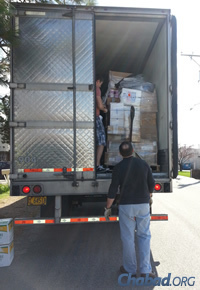
“We’ve been ordering through the Costco in Fargo,” he says. “They can get glatt-kosher meat, but we have to order it in advance. We order 14 to 18 cases four times a year, and then I send out an email, and people tell me how much they want.
“We distribute it, [package it] and take it to the bus station, where we send it by bus to different cities in North Dakota,” he says, adding that “about 15 to 20 families get their meat through this order.”
More and more, the rabbis are finding help from local stores that recognize a market for kosher products around the Passover holiday—and in some cases, throughout the year—even in areas that aren’t known for a significant concentration of Jewish residents.
For instance, a kosher-eating consumer traveling through the Ozarks can find a very limited “kosher section” in a supermarket in Waynesville, Mo., where shelf offerings include boxed matzah and packaged cups of soup even in the middle of winter.
But, caution the rabbis, just because a product is marked “kosher” does not mean that it is, and consumers should check with their local rabbi about certifications for specific brands and products.
The Market Street chain of upscale food stores in some Texas towns, such as Lubbock, Allen and Frisco, offers a very limited selection of kosher food products throughout the year. These selections increase before Passover, according to Eddie Owens, director of communications and public relations at the market’s parent company, United Supermarkets.
Owens notes that they do have customers who request kosher products, but that those inquiries tend to be “infrequent.”
Still, the upscale chain makes it a point to boost its stock at Passover time.
According to David Rossi, vice president of marketing at Manischewitz, “every state in the union has Manischewitz products,” including places like Iowa and Nebraska.
“We sell to all major accounts all year round,” Rossi says. “However, at Passover, most stores stock a broader selection of items.”
Meanwhile, the California-founded food seller Trader Joe’s has also made it easier for kosher consumers by stocking kosher chickens and meats.
Lifshitz, of Idaho’s Chabad, says kosher consumers in his area have been able to get kosher meats without it being special-ordered now that a Trader Joe’s opened recently in Boise.
Still, some people in more remote places will discover road blocks. As Grossman recalls: “There’s a lady in Fargo who asked us to get her kosher-for-Passover margarine last year.
“We went to the store [in another state], but they were out of it, and my wife kept apologizing to her. Then she told my wife, ‘That’s one of the things we’ve learned since moving to North Dakota 30 years ago—if you don’t have something, you do without it.’ That’s an inspiring story for us.”
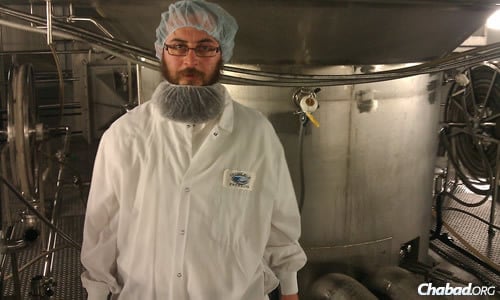
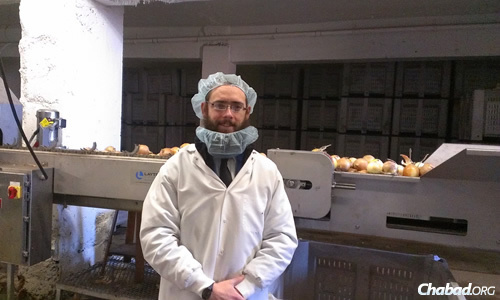
While much of the focus on kosher food is on the retail side, both Rabbi Lifshitz and Rabbi Grossman are also involved in the back end of the industry by providing rabbinical supervision for various products.
“A lot of the products you find in kosher supermarkets in New York are made from potato starch produced in Idaho,” says Lifshitz.
Moreover, at Idaho Milk Products last week, the rabbi oversaw the production of half-a-million pounds of Cholov Yisroel kosher-for-Passover milk protein concentrate and milk protein isolate—forms of milk powder—that get shipped to Israel.
And Grossman oversaw production of peeled onions this year and has previously supervised the manufacturing of sugar.
If there’s one bright spot to not having access to the large number of Passover items available in major cities though, it’s this, says Grossman: “The only things you can’t get are the things you probably don’t want to eat anyway.
“If we were in Brooklyn,” he continues, “we’d probably be stocking up with a whole bunch of kosher for Passover noshes (snacks), but not over here.”








Start a Discussion