


The emails came in from around the world and in a host of languages—English, Spanish, Russian and more. Some letters were written by seniors, others by children. A few of the letters had pictures attached, others not. Most of the writers committed to doing a mitzvah, an act of goodness—be it giving charity, lighting Shabbat candles, increasing Torah study or reciting prayers.
But the letters had two things in common: their message of thanks to soldiers of the Israel Defense Forces, who have been risking their lives as part of “Operation Protective Edge,” and the fact that they were written by readers of Chabad.org, who signed on to Chabad.org’s Write-a-Letter/Do-a-Mitzvah campaign to help Israel during its war with Hamas in Gaza.
“As soon as the military situation in Gaza began, we knew we had to do something,” says Rabbi Mendy Kaminker, editorial coordinator of Chabad.org. “We followed the advice of the Rebbe—Rabbi Menachem M. Schneerson, of righteous memory—who always said the best way to help any situation is to increase in the performance of mitzvot of every kind.
“We thought that if people could dedicate a mitzvah and connect with a soldier, it would have a tremendously uplifting effect on both the soldier and the person taking on the mitzvah.”
After promoting the campaign on all of Chabad.org’s websites—there are eight language-specific sites—and on the websites of Chabad centers around the world, Kaminker says that “we got thousands and thousands of letters, some that included images of a person actually doing the mitzvah.”
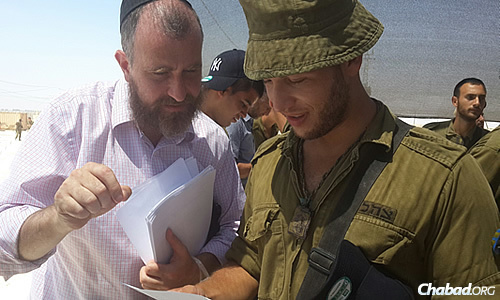
The letters were then sent to the offices of the Chabad Youth Organization in Israel, which distributed them through its Chabad Terror Victims Project to soldiers stationed near the Gaza border. In fact, whenever CTVP volunteers or staff went to visit soldiers, they handed out letters, along with other items or surprises—be it ice-cream, New York Yankees baseball caps, or bags filled with toiletries or snacks.
Getting the Message Out

“It was amazing for the soldiers to get these letters,” says CTVP associate director Rabbi Yossi Swerdlov, who personally handed out some of the letters (and those ball caps provided by a New York-based donor) to male and female soldiers. Noting that the letters were in different languages, Swerdlov says that he held them up and announced, “Who speaks Spanish? Who speaks Russian?”
“They were very excited that the emails were in different languages,” reports Swerdlov. “More than anything, though, they were quite surprised to be getting letters from around the world. They were just shocked; they said they couldn’t believe that people all over the world were writing to them.”
They also felt better knowing that so many people did not pay credence to the spate of negative media aimed at Israel. “It was good for them to see that not everybody feels the same,” attests Swerdlov.

That’s a message the letter-writers wanted the soldiers to understand.
“I don’t know who you are, but I know what you stand for. I know you stand between Israel and its enemies. I know you fight not just for yourself, but for all of us who stand behind Israel,” wrote a young mother from New Mexico, who took on the mitzvah of lighting Shabbat candles. “Whether you are or are not a Jew, the fact that you are a soldier in IDF means that you fight to protect Judaism. For this, I owe you my gratitude. Thank you for protecting my homeland. Thank you for protecting your home. … ”
And an 11-year-old girl in England wrote: “Dear soldier, I support you in Israel. I decided to follow the Lubavitcher Rebbe’s advice and am going to give [tzedakah]. I really do hope the war against Gaza stops soon! Lots of people are supporting you. Good luck.”
For some, though, the work that the IDF has been doing is profoundly personal. As Daiana from Buenos Aires wrote, “I have family in Israel and a sister in Beersheva. Thanks for watching [over] them, and sorry that the world is not more support[ive]. … ”
Each letter also included the writer’s email address, allowing recipients the opportunity to respond, and readers who received a reply from an IDF soldiers are encouraged to share the reply in the comments section of the page.
Even though a cease-fire is currently in effect, the letters are still arriving because, as Kaminker says, “people feel their letters and their mitzvahs are the least they can do—from wherever they are—to send their support.”
Those wishing to join in the effort can click here to participate.










Join the Discussion