

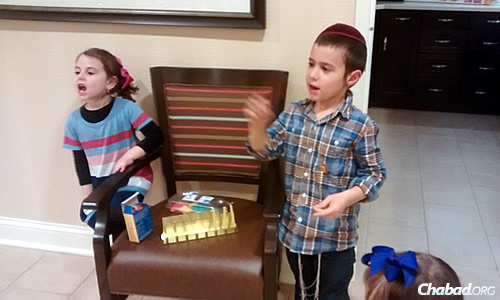
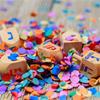
There were six of us in the car, two parents and four children. Night had just fallen, and we were on our way to visit a seniors' residence north of Chicago. Our friends at Lubavitch Chabad of Skokie had supplied us with a box of chocolate coins, a tin menorah and some colorful Chanukah-shaped cookies.
As we drove, we discussed what we would do that night. “If someone wants to hug you, what do you do?” (Correct answer: You can either allow them to or tell them you are not comfortable with it.) “Who knows a Chanukah song we can sing?” (Incorrect answer: Me and my friends made up lots of funny songs in school.)
My wife and I wondered aloud whether or not any of the elderly people would enjoy the Yiddish songs our children had learned in school. When we were kids, there were bound to be Holocaust survivors or Americans who grew up in Yiddish-speaking homes, but that was in the last millennium.
Arriving 10 minutes early, we piled out of the van. The youngest two sat in the stroller; the older ones skipped excitedly along.
The facility was elegantly appointed, with an ice-cream shop, fitness club, library and other amenities dotted around the main floor.
The woman at the front desk handed us a list of Jewish residents (there were 12), and we were off. As we walked to the elevator, I was pleased to see that the children whispered respectfully.
Our first visit was with Michael. He didn’t appear old, but from the way he returned my greeting, I could tell that he was blind. We wished him a “Happy Chanukah!” My 3-year-old gingerly placed a sack of chocolate coins on his lap, but after I explained to her that Michael could not see, she carefully took the coins and placed them in his hand.

At our next stop, the lady we were visiting said she knew the song “I Have a Little Dreidel.” And our children were happy to sing it for her. What I did not realize was that my 4-year-old’s teacher had taught them that the song is to be sung while spinning around.
At one point, we met a nice woman with her grandson. He called her “Bubbs;” so we did, too. And then magic happened. We took out the menorah and lit it. After some more chatting, and, of course, some Chanukah gelt, we left them to spend time together in the candles’ glow.
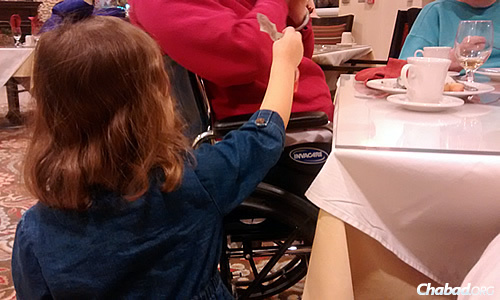
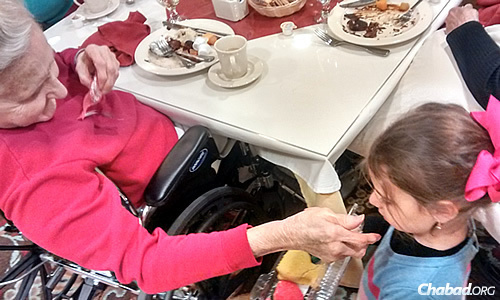
Strolling down the hall, we remembered that we’d forgotten to give out cookies. So from then on, our 3-year-old gave out coins and our 4-year-old gave out cookies—allowing the residents to choose which color, of course. Not to be outdone, our 5-year-old carried the candles.
A Song and a Smile
After we finished visiting all the rooms on our list, we made our way to the dining halls since some people were out eating dinner. There, we met two Jewish gentlemen sharing a table. One of them was sitting with his son and eating a kosher meal. And yes, he spoke Yiddish (his son spoke to him in English, but he replied in Yiddish). Happily, our kids sang “latkele, latkele; hop, hop, hop; hop arien in mein top … ”
Our last stop was the main-floor dining room, where the most mobile residents ate together. The kids gave out cookies and coins to everyone, and my son gladly “lit” the menorah. The waitress was afraid of allowing real fire in the room, so he just recited the blessings (omitting G‑d’s name) and pretended to light the candles.
We gave our last two sacks of coins to the receptionist and the parking attendant, then piled back into the car. As we drove home for our own menorah-lighting and dinner, I wondered if the residents were still thinking about us. What I knew for certain was that we were still thinking about them.






Join the Discussion