

MARIUPOL, UKRAINE—The southeastern Ukrainian city of Mariupol has been on edge for more than a year now, with the thud of Grad rockets falling in the distance a part of daily life.
“During Shavuot, we heard them all day long,” says Rabbi Aron Kaganovski, 30, who assists the city’s chief rabbi and Chabad-Lubavitch emissary Rabbi Mendel Cohen. “It’s strange if you don’t hear them.”
The Chabad Jewish center—nestled amid tall buildings in the center of Mariupol, with its population of more than 450,000—contains the city’s only synagogue and caters to Mariupol’s 3,000-strong Jewish community.
On May 9, 2014, following Russia’s annexation of Crimea, pro-Russian separatists took control of the city. The Ukrainian government has since taken it back, but the war—which has left 6,000 dead and displaced 1 million people, including some 25,000 Jews—remains within earshot, mere kilometers away. A great number of Jewish families and individuals have fled altogether—some to other parts of Ukraine or Russia, and many to Israel. Many of those who remain are elderly.
Today, Chabad institutions on the ground in the east—26 in all, including synagogues, schools and community centers—provide emergency food plans and medical aid to more than 15,000 Jewish community members, much of it in the devastated Donetsk and Lugansk regions controlled by pro-Russian separatists.
Kaganovski describes how two burly men claiming to represent the separatists paid a visit to the synagogue when the conflict first began. “They looked around and said, ‘You look like you need protection.’
“I told them we don’t need any protection; we’ve always been fine,” recounts the rabbi, who then pointed to the aron kodesh, the holy ark containing the Torah scrolls. “There, that’s all we have of value,” he told them. “We have G‑d.”
If any city in Ukraine can symbolize the fear and uncertainty felt by much of the country, it’s Mariupol. Photographer Jonathan Alpeyrie recently traveled there to capture life in this frontline city.
Faces on the Frontlines
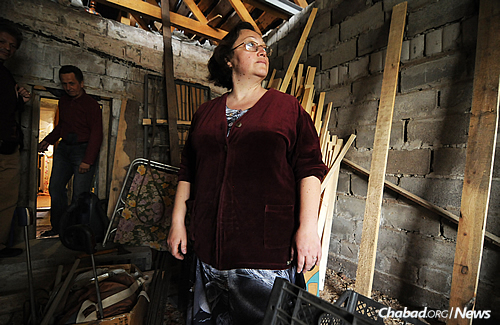
Mariupol’s Jewish community is spread out, and some members, like Natalia Lavushko and her husband, Grigory, live on the city’s outskirts—areas that would be early targets in the event of a new offensive. The Lavushkos have stopped renovating their modest house because Ukraine’s currency devaluation has eaten into their meager income. “Without financial help from the synagogue, we wouldn’t survive. But, thank G‑d, we have our own garden, and we don’t have to buy much of our food,” says Natalia. “In the beginning, when the trouble started, we were worried. But now we laugh. Sometimes, you need to laugh.”
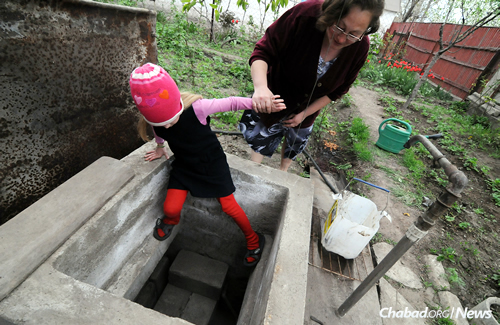
Lifting a metal sheet, Natalia shows the one addition the family made: a makeshift bunker. The couple’s young daughter, Nelli, likes to play in the dank concrete shelter, often with their ginger cat.
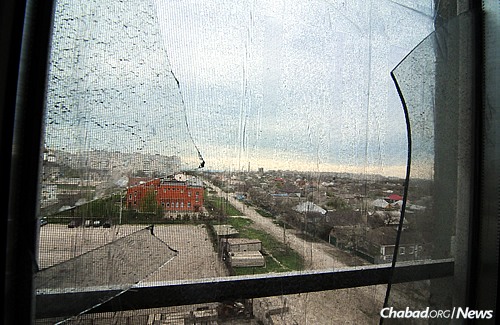
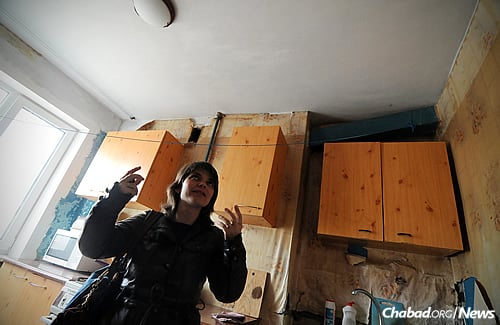
So far, the greatest danger to most Mariupol citizens has come in the form of Grad missiles launched by separatists near the Russian border. On Jan. 24, on a Shabbat morning, a salvo of Grads landed around a market in the eastern part of the city, blowing out the windows in the apartment of Jewish community member Natasha Ralko.
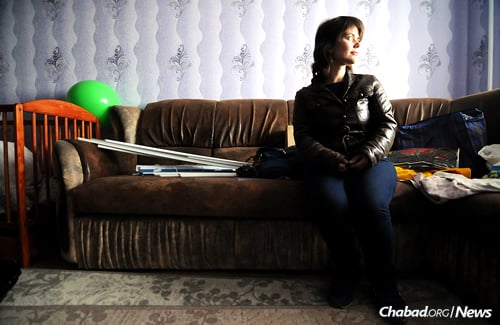
The official death count was around 30, but Jewish community member Natasha Ralko—whose windows were blown out while she was sitting in the living room of her apartment with her daughter and 8-month-old infant, and whose kitchen is now heavily damaged—is convinced that the number is higher. “There were at least 30 bodies just down there around the parking lot,” she says, pointing out of her window to where the burnt-out, rusted hulls of a half-dozen cars remain. “Behind those buildings, there was the market. Everyone was shopping. I was supposed to go shopping, too, but for some reason, I was feeling tired, lazy,” she says. “A short time later,” she continues, “I heard the explosions. My daughter went to the bathroom and threw up.”
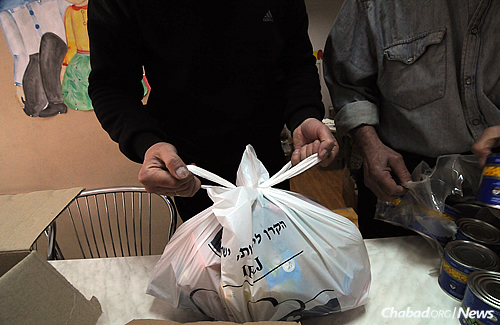
The sharp drop in value of Ukraine’s hryvnia, combined with a lack of jobs due to economic instability, has forced many Ukrainian Jews to subsist on food aid. The International Fellowship of Christians and Jews sponsors regular distribution of packages, called pasiliki, for Jewish communities throughout Ukraine. Here, a volunteer at the synagogue ties a package containing nonperishable items such as oil, lentils and pasta.
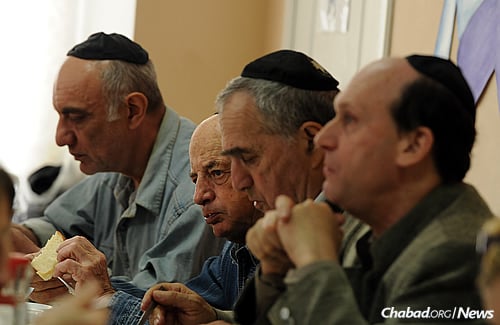
Aside from the Fellowship’s food packages, many Mariupol Jewish community members come to the synagogue to enjoy a hot kosher meal they may not be able to afford at home. While outright starvation is not yet a problem, everyone has had to cut down on the quality and quantity of food they purchase. Instead of meat and chicken, they eat buckwheat kasha and macaroni. Jewish community leaders on the ground say the situation is unsustainable.
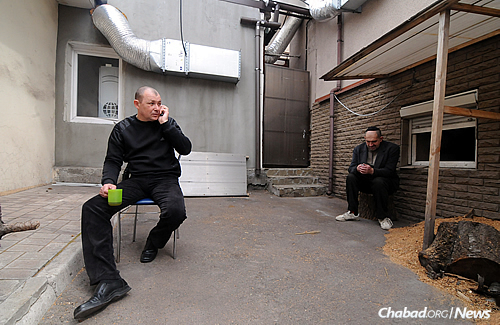
Despite fears of anti-Semitism that some feel can explode at any moment, most of the Jews of Mariupol have chosen to remain there. The Jewish community plays no role politically in the war between Ukraine and pro-Russian separatists, but Ukrainian Jews do not easily forget history; they fear being used as a political football. There is the constant worry of a Russian offensive meant to create a land corridor to Crimea, and on top of that, some Jews also quietly dread the new Ukrainian volunteer battalions that have assumed control of many of the city’s police duties, as some of their soldiers sport Nazi symbols on their helmets. As in most other Ukrainian synagogues, a single guard, above left, provides for Mariupol’s synagogue’s security.

Uncertain times have drawn increased numbers to Jewish programs and synagogue services. In Mariupol, an elderly gentleman prays alone in the synagogue sanctuary, whose doors remain open to all.

Younger people come to synagogue as well, donning tefillin or just to talk to the rabbis. Older Jews who grew up in the Soviet Union fear Ukrainian nationalism; the younger ones tend to view Ukraine as their home and country, one they hope will turn away from its Russian past and towards a European future.

Jewish life in Mariupol has grown rapidly since Rabbi Mendel and Esther Cohen arrived in the city in 2005, as they opened a synagogue, preschool and successful Jewish afterschool programs. While thousands of Jews have fled from Donetsk and Lugansk, the two major Jewish communities in pro-Russian separatist territories, Mariupol’s Jewish population has remained mostly stable, although some have left as well. While Grads may be falling somewhere in the distance, this boy’s Jewish education continues unabated.
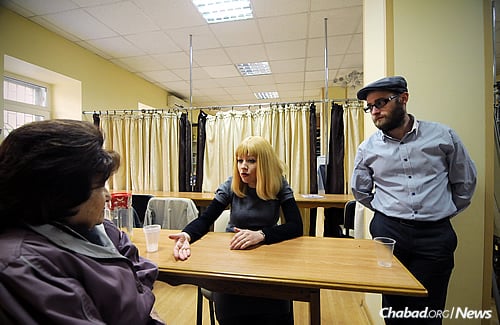
Kaganovski and his wife, Chaya, are both Kharkov natives who, as Chabad emissaries in Mariupol, assist the Cohens in their work. The turbulence and confusion means that the rabbis and their wives have their hands full taking care of their community. Many of the elderly have relied on their government pensions for years, but now find it hard to survive on those amounts, which have not risen despite the hryvnia’s drop in value. Young people are also more likely to move and restart their lives elsewhere, leaving some elderly with little or no family near home.
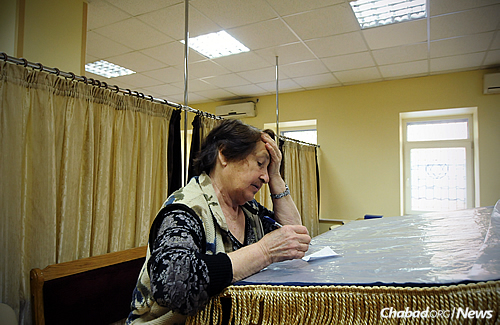
The Jews of Ukraine have lived through much in the last 80 years; Stalinist repression gave way to Nazi extermination. Following the Holocaust, survivors—many of them veterans—set about rebuilding their lives within the limited parameters of the Soviet Union. The Soviet Union’s collapse in 1991 brought instability, and now, after two decades of steadily growing peace and tranquility in a less-than-perfect Ukraine, the shadow of war darkens the future. Here, a distressed Jewish woman writes a note in the synagogue sanctuary.
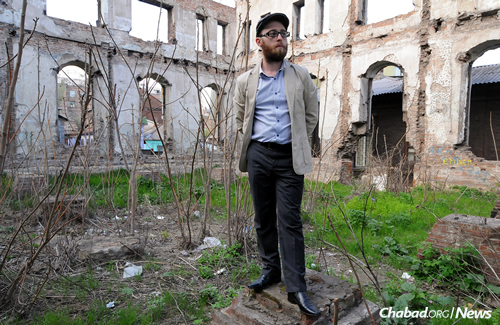
Jews first settled in Mariupol in 1820, as it grew to become an important port city in the Russian Empire. In 1864, a synagogue was constructed on Kharlampievskaya Street, which was eventually reconstructed as a choral synagogue. The grand building was destroyed following its seizure by Soviet authorities in the 1930s; today, only its skeleton remains, which Kaganovski contemplates here.
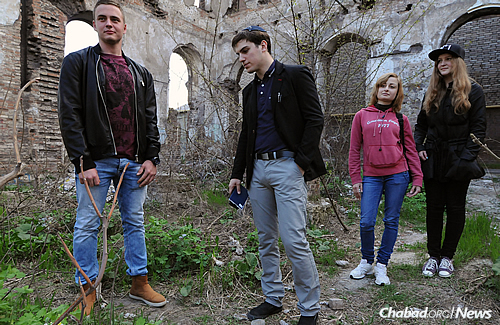
The remains, where the foundations that sat under the bimah and aron kodesh can still be seen, were officially returned to the Jewish community in 2007. Cohen still dreams of rebuilding the old synagogue and returning it to its former place of glory. Mariupol’s Jewish youth group may not remember what the synagogue looked like before its confiscation, but they do know what they hope to see soon: a bright and stable future for themselves, their country and all the Jews of Mariupol.
With their help, they say, the choral synagogue will one day once again open its doors and welcome Jews of all stripes. Until then, they head out into the city, into the world. And pray for peace.







Join the Discussion