


Sydney Persing started reconnecting with her faith in the fall of 2015, her first year at the University of North Carolina. A friend from the fencing team asked her to come to Friday-night dinner at the local Chabad House.
She enjoyed the experience so much that she began attending Shabbat dinners every week.
It was an eye-opener for the now 20-year-old from Northern New Jersey, who grew up in a Jewish home, went to Hebrew school and had a bat mitzvah celebration. But when she was 12, a close uncle passed away, and it had a profound effect upon her. As she relates, “It was a classic story: Child loses relative and wonders how G‑d could exist, and sort of pushes religion out of her life.”
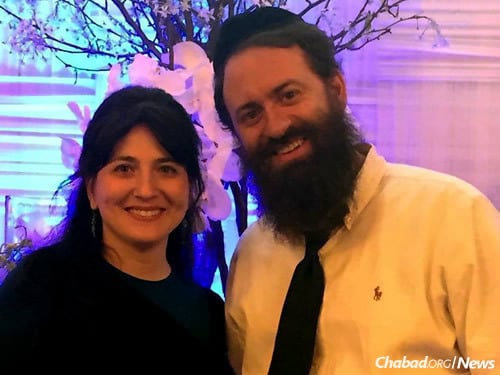
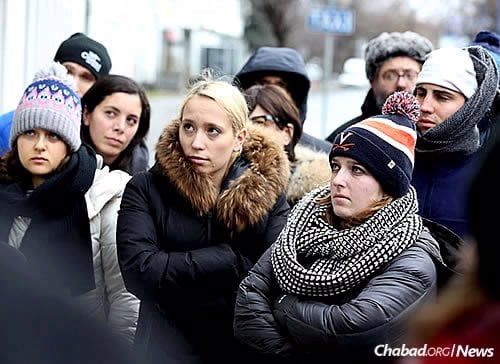
She credits time spent with Rabbi Zalman and Yehudis Bluming, co-directors of the Rohr Chabad of UNC Chapel Hill and Duke University, with helping bring her back into the fold. Persing took that involvement a step further in December, when she decided to go on a Chabad-sponsored trip to Poland with the Blumings. Sites included ghettos, cemeteries and Auschwitz, but also many Jewish historical places that existed long before the Holocaust.
In some sense, the experience completed a circle for Persing.
“If they could do that—if they could strengthen their faith in the face of the atrocities in concentration camps and still be good, practicing Jews—then so can we, and we owe it to those people,” she says. “Especially on a college campus, it’s very easy to say, ‘I have an exam; I can’t go to services,’ or ‘There’s a party,’ but once you see what people sacrificed, it’s very hard to not feel compelled to do everything you can to honor that.”

‘Challenge the Younger Generation’
For their work during the past 15 years—the Blumings arrived in North Carolina in 2002—the Durham-Chapel Hill Jewish Federation is presenting the Earl & Gladys Siegel Young Leadership Award to the couple at the organization’s annual meeting on Sunday, Jan. 22, at the Levin Jewish Community Center in Durham.
“People continue to see both of them as pillars of the community,” says Jill Madsen, CEO of the local Federation. “They are very committed to doing outreach and programming to bring people in, to make sure that people feel welcome.”
Echoing the findings of the Hertog report—a groundbreaking study of the Chabad-Lubavitch movement’s impact on university campuses throughout the United States released last fall—local community members say the Blumings have a unique ability to connect with students and young professionals in an area known as the Research Triangle, where doctorates are plentiful.
“Obviously, we were very humbled to be recognized by the community here,” says Rabbi Bluming, 39. “We have been welcomed by the community with open arms” since arriving in 2002 “and have received tremendous support.”
He notes that he and his wife, 36, now the parents of five children, saw North Carolina as a great opportunity because of its mix of college students, who tend to be more transient, and people who have settled there for the longer term to teach or conduct research.
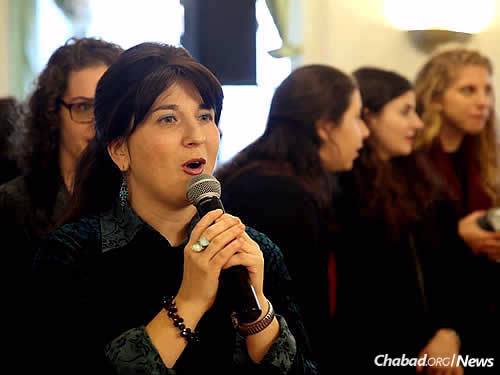

To tap into the intellectual curiosity that exists among Jews in the area, the rabbi often brings in guest speakers on all kinds of subjects over Shabbat. “I feel that it’s incumbent upon us that our Friday-night dinners are more than just about chicken soup,” says Bluming. “We need to challenge the younger generation to think intellectually and be part of the vibrant conversation of Judaism. If Judaism is just a social platform, today students have so many opportunities that compete with it.”
Persing, a double major in political science, and media and journalism, adds that it’s not just the speakers, but also the rabbi’s talks that keep her coming back. “He is able to not lose the roots of what he is trying to teach, while also making it applicable to college students. He doesn’t just get up there and read Hebrew for an hour-and-a-half. He wants kids to learn, and he doesn’t dumb things down.”

‘Above and Beyond’
In addition to their work with students, in 2011 the Blumings opened the Beit Chanoch House of Healing, a residence for caregivers and patients who receive treatment at Duke University Medical Center. They host about 150 families each year.
“It’s been an incredible opportunity,” says the rabbi, who notes that they encourage students to talk with and visit patients, “connecting with them in a real way.”
Madsen says community members recognize some of the “above-and-beyond things” the emissaries have done, specifically with the healing house.
Rebecca Shrago, 31, a dietician at Duke University Hospital, moved to the area in 2014 and started attending Chabad with her sister. “The things I enjoy most are the weekly Shabbat dinners,” she says. “But my sister ended up moving away recently, and I don’t have much in the way of family down here, so it’s been even more of a nice, constant thing to do. If I have nothing else on the calendar for that week, I at least know I have a place to spend Shabbat.”
And when she was conflicted about certain personal issues, she recalls confiding in the Blumings (much of a Chabad on campus couple’s work deals with concerns about relationships, friends, Judaism, the future). Asked about those challenges, Shrago shared: “Just figuring out one’s direction—where to take your career . . . decisions based on where you see your life.”


Start a Discussion