


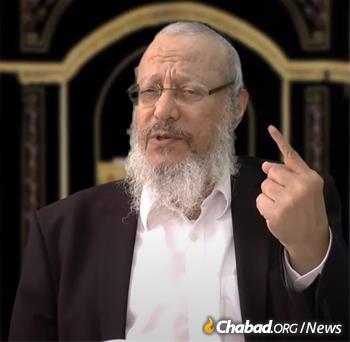
Rabbi Meir Aharon had a meticulous daily routine all his life, never wasting a minute. When he rode the bus each morning from his home in Bnei Brak, Israel, to Lod, where he taught schoolchildren, he’d study seven folios of Talmud. After returning home from a long day teaching, he opened his well-used volumes of Shulchan Aruch, and learned—page by page, chapter by chapter—until midnight.
As a young Torah scholar, Aharon wished to give the Rebbe—Rabbi Menachem M. Schneerson, of righteous memory—a birthday gift for his 75th birthday on 11 Nissan, 1977. He presented the Rebbe with a lengthy exposition on the laws of sukkah, a complex and intricate subject. Months later, the young man received the newest volume of Yagdil Torah, a scholarly journal published by the kollel for advanced students in Crown Heights, administered by the Rebbe’s secretariat. Leafing through the book, Aharon was stunned to see an entry with his byline: “By Rabbi Meir Eliyahu Aharon, Bnei Brak, Israel—sent to the Rebbe shlita in honor of 11 Nissan, and submitted by the Rebbe,” it read. The Rebbe’s appreciation of the essay meant the world to the diligent scholar.
“He was a role model,” says his student of 15 years, Rabbi Chaim Hillel Raskin, today the rabbi and halachic authority in Petach Tikvah, Israel. He studied in the kollel that Aharon had led from 1990 until his passing last month at the age of 70. Aharon’s kollel was a place where young married men dedicated years of their lives to the study of advanced Jewish law, covering everyday topics such as the laws of Shabbat and Holidays, kosher laws, as well as the more specialized areas of practice—family law and monetary law, matters adjudicated by only highly-qualified experts in Jewish law.
Raskin’s own unlikely journey from Burlington, Vt.—where his parents direct Chabad-Lubavitch of Vermont—to a sought-after expert and author on Jewish law in Israel, attests to Aharon’s empowerment of his students. “He would set his eyes on you after learning at the kollel for a while and pushed you further,” Raskin says. “He gave you the feeling of ‘yes, you can do it, you are capable.’ He always made us go much further.”
A Life of Diligent Study
Aharon’s life and sheer diligence showed his students what they could achieve. Born in 1950 in Kfar Saba, Israel, to Rabbi Shalom and Galia Aharon, newly arrived immigrants from Yemen, young Meir’s first exposure to Chabad was at the local Chabad-run day school, administered by Rabbi Moshe Slonim, a spirited Chabad Chassid from Jerusalem whose personality made a strong impact on Aharon. Twice a month, Rabbi Bentzion Lipsker, who would later become the chief rabbi of the desert town of Arad in southern Israel, would test the students on the material they had learned.
Lipsker guided Aharon to continue his studies at Chabad’s Tomchei Temimim of Lod, a yeshivah for high-school aged boys in central Israel. Initially, Aharon and two cousins from Kfar Saba were inexplicably rejected from the yeshivah until the administration received a sharply worded letter from the Rebbe, admonishing them for rejecting the group.
Not long after, Aharon’s father was persuaded to take his son out of the yeshivah and send him to a secular high-school. “He has a good head; he’ll just be warming the benches in a yeshivah,” friends convinced Shalom Aharon. But the more secular environment of the high-school didn’t appeal to the boy, and he returned to yeshivah.
He learned there for three years, enjoying the experience. Upon completing his studies there, he transferred to Tomchei Temimim of Kiryat Gat, a fledgling yeshivah in Israel’s dusty south that had been established a year beforehand.
In 1968, Aharon graduated from Kiryat Gat and together with his peers left Israel for a year of study in Brooklyn, N.Y., near the Rebbe. It was there that he grew into a devoted chassid of the Rebbe and merited his first private audience with the Rebbe—a four-minute meeting that left an everlasting impression.

Advice from the Rebbe
Upon returning to Israel, he married his wife, Dina, and the couple settled in Safed in northern Israel, where he studied in the kollel founded by Chabad emissary Rabbi Aryeh Leib Kaplan. Later, he moved to Bnei Brak, where he headed a Sephardic kollel. When he received a teaching offer at Chabad’s elementary school in nearby Lod, he had a dilemma: Part of him wanted to stay at the kollel in Bnei Brak, an easier, travel-free option, but his conscience told him that he was needed in education. As a good chassid does, he wrote to the Rebbe. The school’s administration warned him that it would be impossible to receive an answer before the school year began in a week-and-a-half. Aharon didn’t budge. One week later, a letter arrived from the Rebbe’s secretariat. “Accept the offer to teach in the yeshivah in Lod,” it said. That was all Aharon needed. He left his prestigious position directing a kollel and became a school teacher.
After years, he felt a calling to once again teach older students. “Take the advice of good friends,” wrote the Rebbe. For a short time, he led a kollel in Bnei Brak, where he taught halachah to aspiring rabbis. In 1990, a new kollel opened in Rehovot, and Aharon was asked to direct it. Under his leadership, it became renowned, producing “the majority of the younger generation of Chabad halachic authorities in Israel,” according to Raskin.
Raskin points to Aharon’s way of taking young rabbis and pushing them to independent decision making as a factor in his kollel’s success at creating the next generation of rabbis. “He was demanding. He pushed. He made you advance,” says Raskin.
The kollel had a website where halachic questions came in from the public, and Aharon would assign his students to answer them. “He threw us in the deep end and told us to swim,” Raskin puts it. Of course, no answer was sent without final review from Aharon, who would critique the written decision, teaching his students how to master the art of responding to halachic inquiries.
Aharon had no entry exam to his kollel; he accepted anyone who showed a desire to learn seriously. Raskin recalls how Aharon once took in a group of teenagers who were struggling in the mainstream yeshivah system, feeling that the kollel atmosphere—and more relaxed schedule with nights off—would benefit them. “I met a fellow in New York once who told me that he is religious thanks to Rabbi Aharon.”
Above all, what stood out was his integrity. “Truthfulness and honesty, no games,” says Raskin, who recalls witnessing a din Torah (a dispute before a Jewish court of law) that came before his teacher. When one side gave their story, Aharon immediately recused himself. “You once came to me privately with this question,” he explained. “I can no longer serve as the dayan (‘rabbinic judge’).”
“He lived his life without fanfare, calmly and diligently doing what he did,” says Raskin. “His life’s work—the kollel—will go on.”
In addition to his wife, Aharon is survived by his 12 children: Rabbi Daniel Shaul; Rachel; Rabbi Levi Yitzchak; Rabbi Shmuel; Leah; Sarah; Rabbi Yisrael; Rabbi Mordechai; Rabbi David; Chaya Mushka; Rivkah; and Rabbi Moshe; in addition to many grandchildren.




Join the Discussion