

When Rabbi Mendy Mentz moved to California last year with his wife, Dobbie, to establish Chabad of West Bel Air in the Los Angeles area, it was four weeks before Rosh Hashanah, and the Delta variant of the coronavirus was on everyone’s mind. Even though the Mentzes made clear they would be following the strictest levels of precautions at the services, the rabbi only purchased 20 machzors (High Holiday prayer books), expecting a small turnout. He was in disbelief when almost 300 people registered for Rosh Hashanah and Yom Kippur services, leaving them with standing-room only. The reason behind the unexpected turnout is a phenomenon that began two years ago and is still growing.
Being mindful of everyone’s health and safety was crucial to Abigail Goldberg, who attended last year’s services in Bel Air, but explains the more important reason why she will be coming back again this year: “We are looking for authenticity, and that’s what you get when you walk into Chabad,” she tells Chabad.org. “The rabbi talks about being proud Jews to a new flock of Jews. He tells us what’s fun about Judaism.”
Goldberg adds that the services are well-paced and meaningful, “leaving you with something to think about for the next three months. It has the right energy and balance.”
Scenarios like this are poised to repeat themselves all across the country this year, with pre-Covid regulars not only returning but bringing their friends along. Adding to the numbers, individuals and communities around the world are planning to attend and host gatherings in synagogues, homes and any other available venue during this upcoming Hakhel year.
The Spirit of Hakhel to Boost Participation
In ancient times, once every seven years, Jews would stream to Jerusalem before the holiday of Sukkot to unite in the Holy Temple, and hear Torah from the king. In modern times, celebrations of Jewish unity and pride throughout the Hakhel year were encouraged by the Rebbe—Rabbi Menachem M. Schneerson, of righteous memory.
Altogether, Chabad centers around the nation are expecting record attendance this High Holiday season—at least 15 percent higher than previous pre-Covid records.
This dramatic increase does not surprise Ira Sheskin, professor of geography at the University of Miami and one of the foremost experts in Jewish demography. “We’re going to see an upturn [in synagogue attendance], and I think it will eventually come back down but settle at a higher level than before,” he predicts. “People saw how after not having human contact for so long they really want to go to services.”
Naturally, having a strong presence across the country, in major metropolitan areas and in smaller, rural cities with little to no other Jewish infrastructure, Chabad-Lubavitch will absorb many of those seeking out spirituality and meaning at this time. Sheskin highlights the findings of the 2021 Pew study which found 38 percent of American Jews engage with Chabad, echoed by a 2014 study Sheskin led in Miami, which found that almost 50 percent of households under the age of 35 are involved with Chabad programs. The 2020 Metropolitan Chicago Jewish Population Study found that Chabad had the highest levels of engagement of any single Jewish community in Chicago with particularly high engagement in the in-person category.
In addition, a broad decline across other denominations has meant that former members are increasingly turning to Chabad. A 2020 study by urban and societal trends experts Joel Kotkin and Edward Heyman shows that amid a nationwide, universal decline in the number of synagogues since the 2001 U.S. Synagogue Census—a 29 percent drop—Chabad has been an outlier, experiencing threefold growth. During the same time frame, they found that the number of Chabad synagogues in the United States had gone from 346 to 1,036 with centers now in all 50 states—this number excluding Chabad on Campus chapters, mikvahs, schools, youth centers and Chabad Young Professional communities, with Chabad on Campus and Chabad Young Professionals offering High Holidays services and year-round services as well.
The Importance of Physical Community Gatherings
In Miami’s Highland Lakes, Dr. Jerry Reich, a retired cardiologist who has recently become a regular attendee at Chabad Chayil in Highland Lakes services, cannot stress the importance of physical community gatherings enough.
As a physician, he says he feels safe at Chabad. “They’re doing a good job protecting people. I feel less anxiety, and it’s a very friendly environment.”
More than the obvious physical health protocols, Reich observes a critical element under the surface, fulfilled by the Hakhel year observances. “Especially when coming out of a pandemic, the concept of community and friendliness is so beneficial. It has a physical impact on health, the connection between the emotional and the physical. Research shows that people who interact with community do better health-wise.”
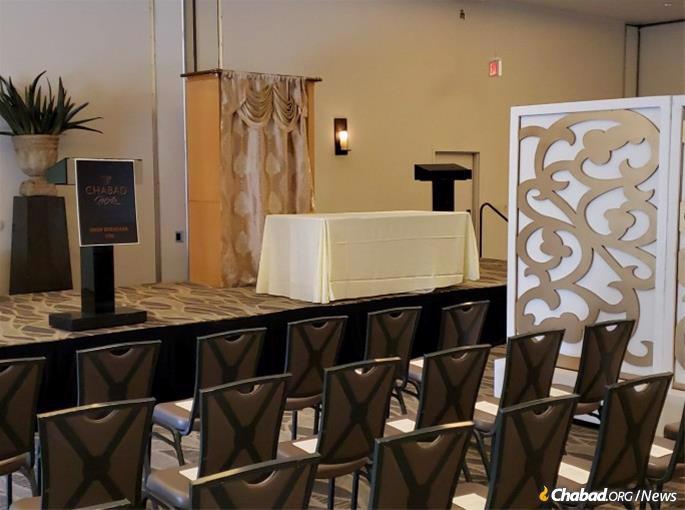
Reich’s rabbi, Rabbi Moishe Kievman, co-director of Chabad Chayil in Highland Lakes with his wife, Layah, is expecting hundreds over the High Holidays—a marked increase over previous years’ attendance. Chabad’s sanctuary will be standing room only, with more than 115 adults filling the room, and 60 kids participating in a children’s program nearby. Chabad’s communal holiday dinners will host 110 people at every meal and more than 300 will join them for the tashlich service. Outside the Chabad center, there will be shofar blowings on the hour, allowing hundreds more to observe the primary mitzvah of the holiday.
Of the three congregations on the block, Reich says he feels most comfortable at Chabad. “I was raised more secular, Conservative, but at Chabad, I felt like a participant, not a spectator. And Chabad has so many children, which I find comforting for the future,” he says.
In Monroe, N.J., a city with a median age of 59 and large seniors’ communities, many are still uncomfortable with attending an indoor service.
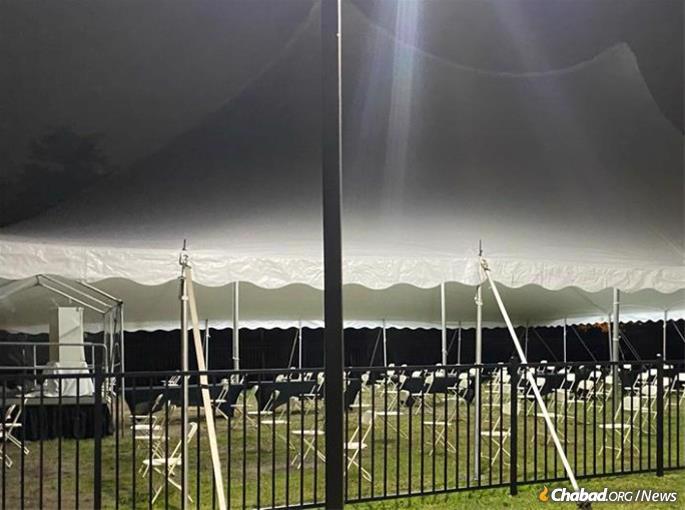
Adapting to that reality, Chabad of Monroe Township, led by Rabbi Eliezer and Chanie Zaklikovsky, will host about 350 people in an open-air tent while simultaneously coordinating smaller services in gated retirement communities throughout the area. With the closure of another congregation in town (a pandemic casualty), Chabad has become a home for many of their former members.
The Jewish year of unity couldn’t come at a better time for Monroe, Rabbi Zaklikovsky tells Chabad.org. “The lack of togetherness the pandemic brought here is astounding. People moved here for the purpose of being together with like-minded people of the same age-bracket.” The shared activities, hobbies, social and religious life has “almost been completely halted.”
Zaklikovsky says “davening together is very meaningful and will go a long way to restoring the unity people have come to appreciate, living in Monroe.”
In Chicago, 3,000 From the Former Soviet Union
In Chicago, Chabad’s F.R.E.E. (Friends of Refugees of Eastern Europe) community will see a staggering 3,000 Jews, many of them from the former Soviet Union, participate in their High Holiday services. Across F.R.E.E.’s four locations—Chicago (led by Rabbi Levi and Pessy Notik); North Suburbs (led by Rabbi Shmuel and Shternie Notik; Rabbi Sholom Ber and Sarale Notik; and Rabbi Aharon and Chava Rendler); Niles (led by Rabbi Naftaly and Raizel Hershkovitch, and Rabbi Lazer and Rivky Hershkovitch); and Uptown, led by volunteer rabbinical students—record numbers will participate in F.R.E.E.’s 43rd-annual High Holidays services.
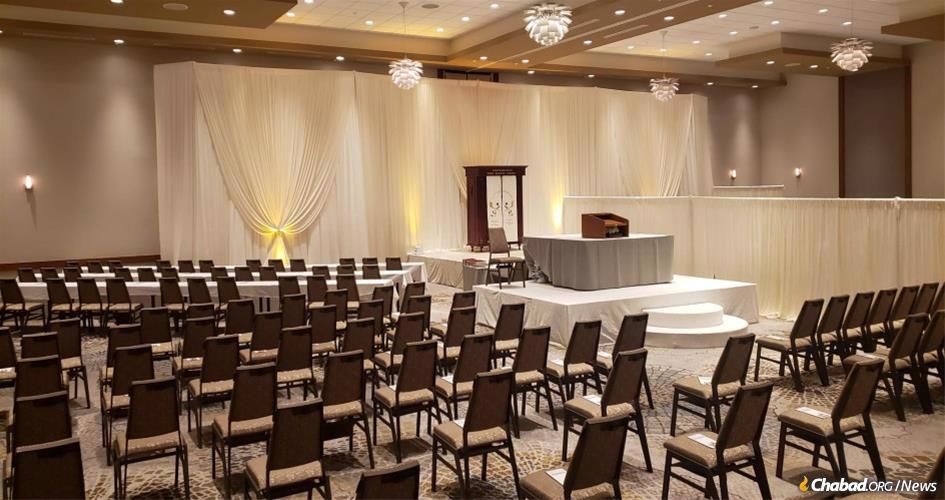
Pre-Covid, F.R.E.E saw approximately 2,300 High Holidays participants, and the team is gearing up for their biggest year yet. The North Suburbs location is preparing for 1,500 participants in a massive ballroom secured for the occasion. Rabbi Shmuel Notik and his wife, Shternie, lead that congregation, assisted by four additional emissary couples, along with a team of cantors and volunteers. The service is interactive, with running commentary throughout and transliterations of key prayers and chants, in addition to the Russian-language Machzors.
“The service grows from year to year,” explains Notik. “We improvised during Covid despite the odds, offering socially-distanced services and making everything safe and comfortable. People who weren’t going out are now coming back in numbers never seen before.”
The Chicago location is expecting 800 attendees, up from 600 in 2019, while the Niles location will see 500 join, up from about 420 in before Covid. Uptown expects about 200, also a record number.
There’s a Pulsating Energy in Town
“There’s a pulsating energy in town,” says Rabbi Shalom Moshe Paltiel, co-director of Chabad of Port Washington, with his wife, Sara Esther. “People are excited to come back, they crave that in-person interaction. Virtual communication only goes so far.” Paltiel notes two factors that are leading him to expect larger crowds than before: “It’s very clear to us that people have a renewed interest in connecting to G‑d and spirituality. The past few years were confusing and a mixed bag of emotions and experiences; they’re running back to shul.”
Additionally, Chabad remained open and available to the community during the pandemic, and services are still being held in an outdoor tent after polling the community to see whether it was still something people wanted. Two staggered services on each day will see more than 800 people fill the massive tent, and Paltiel says they have the capacity to expand the size to accommodate a likely influx.
“We made the services more special last year by bringing a choir to sing with us,” adds the rabbi. “It was a huge hit, and we’re doing it again this year.”
“The theme of our entire holiday season is Hakhel and the power of community,” he says. “We’re better together.”
Rabbi Sholom Ber Notik says he’s looking forward to the moment the ark is opened and the Torah is taken out. “It’s the high point of the service. It’s the closest thing we have to the original Hakhel in the times of the Temple in Jerusalem, when the king would face the myriads of Jews with his Torah and inspire them to rededicate themselves to G‑d.”





Join the Discussion