

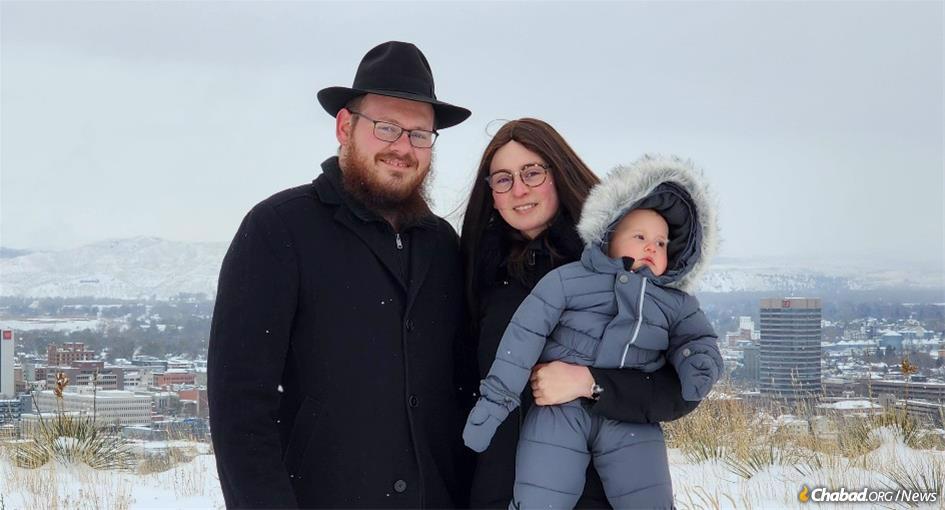
On Sunday, Nov. 20, legions of Chabad-Lubavitch rabbis and guests—an expected 6,500 people—will gather for the culmination of their annual gathering in New York. Joined at the International Conference of Chabad-Lubavitch Emissaries (Kinus Hashluchim) by supporters from their local communities, they’ll sit down to the largest sit-down dinner in the New York area. Since last year’s conference, more than 120 new couples have joined their ranks, doubling down in large cities such as Phoenix, London and Tel Aviv, and charting new waters in more remote locales like Tenerife, the largest of Spain’s Canary Islands—where the island’s new emissaries will be the only rabbinic couple for hundreds of miles.
Over the past year, Chabad has launched a staggering number of projects—many in multiples of 120—honoring 120 years since the birth of the Rebbe—Rabbi Menachem M. Schneerson, of righteous memory, in 1902, in Nikolayev, Ukraine. This includes the 120 new shluchim (emissaries) couples dispatched over the last year, on average one every three days. Many of the initiatives, like the new emissaries, were announced at last year’s conference by Rabbi Moshe Kotlarsky, vice chairman of Merkos L’Inyonei Chinuch, the educational arm of Chabad-Lubavitch. Another project he announced at the time was the writing of 36 new Torah scrolls for Chabad centers that don’t yet have one of their own; this year's conference banquet will culminate with the historic completion of these 36 new Torah scrolls, all of which will then travel to their new homes with the rabbis receiving them.
Among the initiatives highlighting Chabad’s growth was the completion of 120 new mikvahs. Greensboro, N.C., has a new mikvah that’s generated considerable excitement about the mitzvah. Melissa Burzler moved to Greensboro in 2019 from Massachusetts, where she belonged to Chabad of Longmeadow. “I was traveling for three hours to go to mikvah in Charlotte, it took up an entire day. I’d get home at 2 a.m.”
She says Rabbi Yosef and Hindy Plotkin, co-directors of Chabad-Lubavitch of Greensboro, had been planning the mikvah since 2019, but it was delayed due to the pandemic. The new mikvah, she reports, is stunning. She says this is everything she was hoping for, and “it shows that they really care about the community.” In fact, the new mikvah has helped anchor communal expansion. Burzler knows of several other women who have begun using the mikvah and says she has more friends who want to start once they get married.
The programs that have been initiated over the past year follows decades-long trend of growth at Chabad. From communities for young professionals to campus centers, from urban sprawls to rainforests, with a demographic shift underway on every continent, Chabad continues to be on the ground providing meaningful, ever-expanding Jewish engagement around the globe.
In 2020, a 2001 survey of United States synagogues was replicated and found that the number of Chabad congregations had grown by 199% in the preceding two decades. Also in 2021, Pew Research Center reported that 38% of Jewish Americans frequent a Chabad center or event.
The ongoing expansion has impacted every area of Jewish life, especially Jewish education. Since 2021, 10 new Chabad-Lubavitch day schools have opened in collaboration with Tamim Academy, in communities as diverse as Burlington, Vt., and Greenwich, Conn., offering affordable, innovative Jewish schooling.
“This year is a Hakhel year, a year of Jewish gathering,” notes Rabbi Moshe Kotlarsky. “We look forward to welcoming the thousands of emissaries to New York. In the Hakhel spirit, our emissaries are gathering Jews in every corner of the world, expanding and building new communities and making Judaism more accessible than ever before to every single Jew.”

A New Center Every Three Days
The dedication of the men and women of Chabad to uproot their lives to serve Jewish brethren across the globe, sometimes very isolated ones, can’t be understated in the context of Chabad’s growing impact.
In a 1961 address on the holiday of Purim, the Rebbe laid out starkly what needed to be done to ensure the flourishing of Jewish life, no matter where: “It’s been several years that I’ve been saying that we cannot be [swayed by the benefits of] living only on these few streets [in an established Jewish community] ... where you can obtain fresh kosher milk daily ... and you wish to serve G‑d only here and you won’t move from here. When they tell you: ‘Listen, there’s a barren land, a developing country, and there are Jews there who do not know they are missing anything.’ ... You must dedicate time to travel to these Jews and spend a day with them, a week, a month, a year, 10 years—as long as you are needed—and G‑d will give you the years you need for your work there ... ”
“The only people that are doing this are Chabad,” says Nick Beck of Worthing, England. A growing area on the British seaside, it hasn’t had a synagogue since the 1930s, says Beck. “Worthing used to be called ‘G‑d’s waiting room,’ but now it’s up and coming, young people are moving here for the more affordable lifestyle.” In an area with more than 1,000 Jews according to a recent census and with the closest synagogue in Brighton, 11 miles away, Beck, who used to serve as a leader of the community in Worthing, says Chabad coming is “desperately important.” His dream will be fulfilled when Rabbi Shaya and Mushky Gourarie will land at Heathrow before Chanukah to establish the U.K.’s newest Chabad center.
“The family atmosphere at Chabad is amazing,” says Beck, who’s been a regular at Chabad of Brighton, the next town over. “My Hebrew isn’t great, but I am welcome and feel that I am contributing. I’ve seen Chabad all over the world, and they get people involved.”

Like in Santa Teresa, an idyllic beachfront town on the Pacific coast of Costa Rica.
“Welcome to our Chabad center,” gestured Mali Tal, a longtime Israeli expat in Santa Teresa, as she spoke with Chabad.org via video call. People are sitting, eating breakfast and chatting as Mali walks through the building. “We just finished the morning prayers, which we have each Monday and Thursday, followed by breakfast,” she explains. The Chabad center blends in with the surroundings, with some of it partially enclosed, and it’s a simple structure, but buzzing with activity. “When we came here 21 years ago, there was nothing,” says Tal. “We came—seven families together—and built this place. It was a jungle before. We built homes and a hotel.” Tal came with her two children, and it was important to her that they experience their heritage and celebrate the Jewish holidays. “Rabbi Spalter of Chabad of Costa Rica frequently sent us Chabad rabbinical students and we loved them.” In fact, Tal says with pride, she’s stayed in touch with every Chabad rabbinical student who visited her little slice of paradise.
“I have tears in my eyes thinking about this,” she says emotionally as she recalls the young rabbis who’d come to help her for the holidays. “They’d build a sukkah, make sure we all blessed the lulav and etrog. They always went the extra mile.” Several years ago, Tal had a bad motorcycle accident. She went to the clinic to get herself checked out. “As I got there, I got a call from one of these young rabbis from New York. ‘I was just at the resting place of the Rebbe, and I prayed for you,’ he told me.” Tal was floored. At the exact time of her accident, a rabbi thousands of miles away decided to pray for her. “I couldn’t believe it! I told him I had just survived an accident.”

“We viewed our synagogue as a partnership between us and Chabad of Costa Rica,” says Tal, explaining how the Chabad of S. Teresa center came into being in 2022 after years of preparation. “Years ago Rabbi Spalter promised us that one day he would send a Chabad couple to help us run the community.” Six months ago, Spalter told her that he’d be sending Rabbi Berel and Chana Dubinsky.
“They ran Rosh Hashanah beautifully; it was huge,” says Tal. The growing community now numbers around 300, and events regularly attract upwards of 500 with tourists joining in. “What we were really missing was a rabbanit (a female spiritual leader in Hebrew, or rebbetzin in Yiddish). We fell in love with Chana. She invites us to her home, she teaches the parshah so well—the women love it. She’s started a women’s art circle, and it attracts people who wouldn’t otherwise get involved. We lucked out with Chana and Berel.”
Rabbi Dubinsky says he hopes to build a mikvah, a preschool, and a new community center, and will soon be opening a kosher restaurant.
“There is nothing like Chabad in the world,” Tal says emphatically. “Only the Rebbe saw the need to spread Judaism this way.”
New Centers Parallel Population Shifts
While the Chabad expansion is indeed worldwide, a great deal of it is taking place in the United States. The population shift underway in America, partially accelerated by the pandemic and changes in the workplace, means people have been moving to suburban or rural areas, particularly in the West. U.S. Census data from 2021 shows small towns across the West and Southwest growing faster than in any other region, while Phoenix was the second-fastest growing city in the nation, all owing to domestic migration.
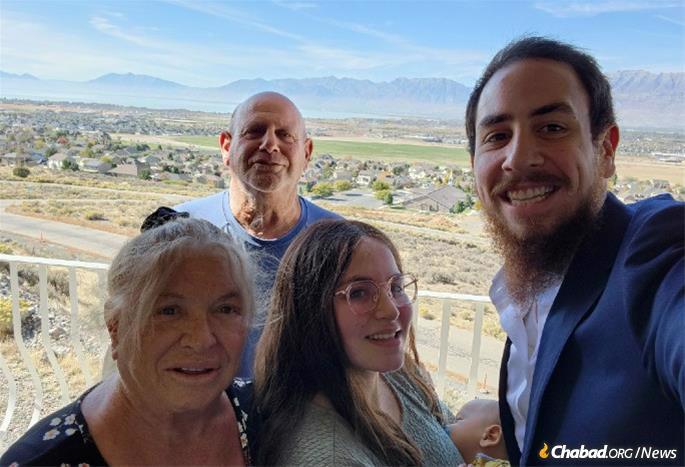
Utah is home to some of the fastest-growing cities in the nation, such as Lehi, about 30 miles out of Salt Lake City. While the city built at a dizzying pace, Jewish opportunities were non-existent, says Tracy Anderson, who’s lived in Lehi for eight years. “There are quite a few Jewish families here and we had nowhere to go.” Anderson reported matzah and gefilte fish flying off the shelves in the local stores before Passover and suspected that there were more Jews in Lehi than people realize; they just needed someone to gather them. Two weeks ago, Anderson received word from Chabad-Lubavitch of Utah that they’d be adding a fifth location in the state: Lehi, to be led by Rabbi Chaim and Esty Zippel, whose parents, Rabbi Benny and Sharone Zippel—whom Anderson has known for 20 years—direct Chabad of Utah.
“Everyone was texting each other to share the good news,” says Anderson. “My son is so excited; he’s finding Judaism again, and it’s Chabad that’s taken him in. He wants a bar mitzvah, and he wants to be involved. We’re all just thrilled.”
Anderson isn’t surprised Chabad is the first Jewish organization in Lehi. “Chabad is the most present in Utah because they’re welcoming; people love it because they make it spiritual and not political.” She hopes this will bring a sense of community to the Jewish families scattered across Utah County and give the local children more opportunities for Jewish enrichment. “We’ll finally have a Jewish community!” she announces.
Further south, Arizona added six new emissary couples to their growing team, now numbering 46 across the state. Four of the six have moved to the greater Phoenix area, one to Tucson and another to Lake Havasu City—a town on the California state line picking up some of the exodus from Southern California.
In Phoenix, a new Chabad center for the Israeli expat population has just been established by Rabbi Shneor and Chanie Feigin, and Rabbi Levi and Chaya Minsky have recently founded Chabad of Ahwatukee, in the Ahwatukee Foothills neighborhood in the East Valley.
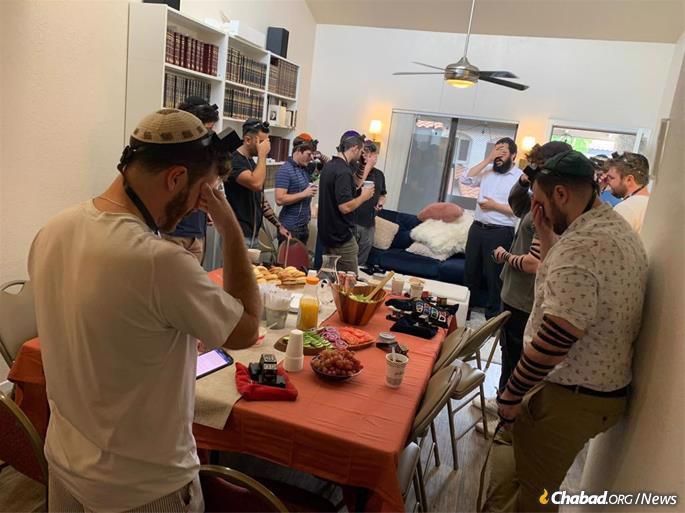
Louis Shulman, 23, a native of Las Vegas moved to Scottsdale, Ariz., just eight weeks ago for its vibrant young professional scene. Looking for a Jewish event in town so he could find community, he stumbled upon a Simchat Torah party listed on Eventbrite. It was the first large event that new shluchim Rabbi Shmuli and Mushkie Bronstein were arranging, having moved to Scottsdale just weeks prior to found Chabad of Downtown—South Scottsdale, a young professionals community under the umbrella of Chabad of Scottsdale, directed by Rabbi Yossi Levertov.
“I’d been switching jobs, working all remotely and traveling,” says Shulman. “Once I had decided that travel was over, I wanted to live somewhere new. I think Scottsdale is the best city—the best for young professionals. The weather is nice, it’s livable, rent is fair compared to the big cities; it’s spacious, and the people are my type.”
Shulman went to Chabad’s Simchat Torah event and enjoyed it. He met the rabbi and stayed in touch. Two weeks later, he joined a BLT (“Bagels, Lox and Tefillin”) at the Bronstein home. “We had breakfast, said the blessings before eating and put on tefillin—I like doing tefillin.”
Shulman brought a friend for coffee with the rabbi and discussed Jewish ideas and learning, and says that Chabad will soon be starting a Lunch and Learn, which he’s keen to join. “For someone like myself, it matches my interest level, it’s about the practice of Judaism, not merely being a spectator in a synagogue,” Shulman says about his experience at Chabad.
Scottsdale wasn’t his first encounter with Chabad: In college, he’d been a regular at Chabad at the University of Alabama in Tuscaloosa, led by Rabbi Kussi and Rosie Lipskier. “My frat was loyal to Chabad; we went all the time. Chabad was more wholesome and family-oriented, more genuine and personal” than other Jewish groups on campus, feels Shulman.
The Drivers of Involvement With Chabad
The experiences people have with Chabad as they progress through life is often what drives their involvement with their local Chabad center. Teens who have engaged with Chabad’s CTeen program become involved with Chabad on Campus, move on to Chabad Young Professionals in the big cities and eventually move to a family-oriented Chabad center in a suburban neighborhood and enroll their children in Chabad schools. People who become involved with Chabad in one area of the country continue that involvement after they move, or when a new Chabad opens up in their city.
On the other side of the country, two new Chabad centers have opened in Vermont: Chabad of Northwest Vermont in South Burlington, led by Rabbi Shmuel and Gittel Grossman, and Chabad of Stowe, led by Rabbi Baruch and Sara Simon.
Stowe is a small town of about 5,000 in northern Vermont, frequented by skiers and vacationers. Surrounded by mountains and at an elevation of more than 800 feet, it’s known as the “Ski Capital of the East.” Jews are spread out over the region, says Eric Friedman, a resident of Waterbury Center, about 10 miles outside Stowe. There are lots of Jews in the area, he says, but there hasn’t been much of an effort to gather them. “We didn’t have a community that appeals to Jews who want a traditional experience and the beauty that Chabad brings. Now we’ll have one in our backyard,” he enthuses.
He’s been involved with different Chabad centers for more than 30 years: before moving to Vermont (“When Chabad was only in Burlington”) he was close with several Chabad rabbis in South Florida. “For years, we’d been hoping for a Chabad in the area; finally Rabbi [Yitzchok] Raskin (regional director of Chabad of Vermont) made it happen.”
“Rabbi Baruch and Sara are amazing. To have a Shliach here that happens to be so charismatic—and has a great drive—it’s attractive to other Jews who might’ve been intimidated. He makes everyone feel comfortable.” Friedman’s hope is that Shabbat services will soon begin, and he’d love to see more kosher offerings in the local stores, “and adult education, a preschool one day—it’s all possible.”
“We really needed Chabad here. I know they are going to build something great,” says Friedman.
In Billings, Mont., locals are similarly thankful for Chabad’s new presence. Rabbi Shaul and Mushky Shkedi moved to Billings—another city that has seen a major population increase over the past several years—in the summer, and Elliott Oppenheim, a community member who recently moved from Missoula, Mont., where he was involved with Chabad there, says they’ve been working tirelessly to make more contacts and bring together the Jewish community. “We had a wonderful High Holidays, the rabbi made everyone feel included. They’re doing everything they can to bring Yiddishkeit here,” says Oppenheim. “They’re bringing the flame of Chabad to Billings—and it ain’t easy.”
Still, he says, despite the challenges, like access to kosher food, he’s certain they will succeed. “He’s a wonderful young rabbi, full of enthusiasm.”
Oppenheim says that a particular blessing of having Chabad is to guide Jews who’ve fallen prey to missionaries of other faiths, something he says happened due to the void before Chabad came. “Rabbi Shaul and Mushky are a candle in the darkness, and it’s so moving that they’ve decided to come here.”
A Safe, Nurturing Jewish Environment for Teens
Rabbi Dovid and Talya Goldschmidt, who were both members of Chabad teen network (CTeen) last decade, have gone on to become shluchim in their own right, heading the new CTeen of Atlanta. “A lot of people are really happy they’ve moved here,” says Ari Gordon, 16, a high-schooler in Atlanta. “Teen involvement is really important and something there isn’t enough of.” Gordon met Rabbi Goldschmidt right after the couple moved. “He came to my house with a Rosh Hashanah gift and told us about CTeen. I started going to events and getting more involved.”
Gordon has just joined CTeen U, a learning program run by CTeen and accredited by Yeshiva University, which gives students college credits for Torah study. “We have our first class tonight,” he says. He credits CTeen’s popularity to their leaders, who are “relatable to teens, young and engaging.” Additionally, he says that CTeen provides leadership opportunities to teens “who really want to be involved and have a say. I think this is a great way of engaging teens.”
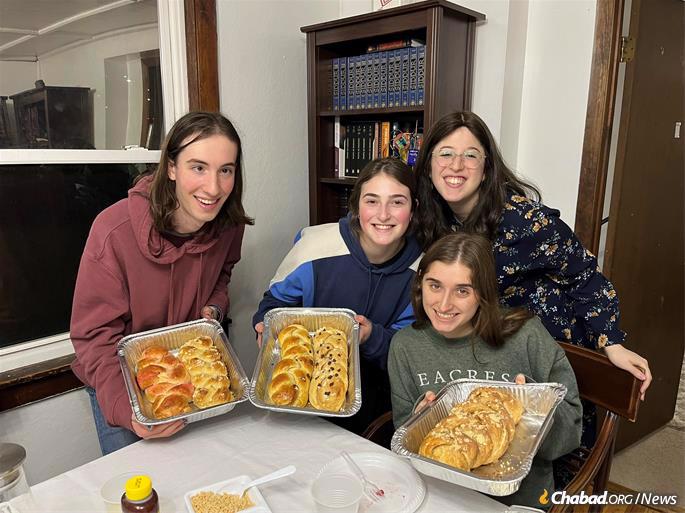
Many CTeeners continue with Chabad through their college years, like Noah Rozensweig, 19, a sophomore at Ithaca College in upstate New York. “I’ve always been involved with Chabad, I grew up going to Chabad of Dix Hills on Long Island and CTeen of West Suffolk. I’m so thankful for that, it was really fun.” Arriving at Ithaca, and feeling a desire to display his Jewish pride, he challenged himself to center Shabbat in his life. When he heard there was a new Chabad on campus, directed by Rabbi Raffi and Chana Filler, it lifted a weight off his shoulders.
“Their being here cultivates an environment where I can come for Shabbat, every week, Friday night and Shabbat day. It’s really encouraging emotionally and spiritually,” says Rozensweig, a physics major and mathematics minor. “I’m trying to move forward in my spiritually observance, and with Chabad there is always family waiting for me. I can visit relatives in Oklahoma or Israel and have a sense of home; I can walk into Chabad for Shabbat dinner and be transported to a place of comfort.
In an atmosphere where many people “feel the need to hide part of their identity, Chabad is a place you can be yourself. It’s where you have an instant family vibe, where you know you’re safe. The rabbi and Chana are my family.”
The banquet celebration of the International Conference of Chabad-Lubavitch emissaries will be live-streamed on Sunday, Nov. 20, starting at 4:30 p.m. EST, on Chabad.org /Kinus.






Join the Discussion