

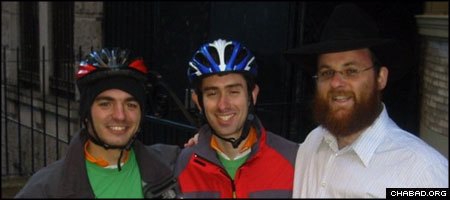
A team of 20 American students and graduates took to their bikes on a 4,000-mile journey to heighten cancer awareness and raise money for cancer treatment and research.
Made up mostly of undergraduates from the University of Illinois at Urbana-Champaign, the Illini4000 team set off May 23 from New York City, where they spent the previous night preparing for their trek at the Chabad Resource Center of Columbia University. By the middle of this week, the effort had raised $50,000, which will be split between the American Cancer Society and Camp Kesem, a summer camp for pediatric patients and survivors of cancer.
Speaking from western Pennsylvania on Wednesday, Illini4000 co-founder Jonathan Schlesinger said that the trip is all about human compassion.
“I can’t tell you how many times complete strangers have gone out of their way to help,” said Schlesinger, an Illinois graduate. “When one considers the fact that we sleep on the ground and eat peanut butter and jelly sandwiches to keep our costs down, this support – be it through shelter, food or a hot shower – not only allows us to increase our donation, but it also provides the invaluable moral support that we need to face the wind, rain and mountains each day.”
Referring to the Columbia Chabad House, where co-directors Rabbi Yonah and Keren Blum provided room and board to the riders, Schlesinger said that their night in New York “would have been a nightmare had it not been for the shelter, advice and moral support that they provided on the eve of [the] departure.”
The riders’ route has taken them through Philadelphia, Baltimore, Washington, D.C., and Pittsburgh, Pa. Their journey will continue through Columbus, Ohio, Indianapolis, Champaign-Urbana, Ill., Chicago, Madison, Wis., Minneapolis, Mt. Rushmore, Yellowstone National Park, Missoula, Mont., Portland, Ore., Astoria, Ore., and Seattle, where Rabbi Elie and Chaya Estrin will host a congratulatory barbeque at the Chabad House serving the University of Washington.
Recording Survivors’ Stories
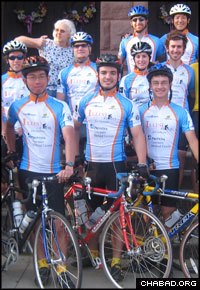
Schlesinger emphasized that a prime component of the trip is to speak to cancer survivors and patients.
“Our interviews, conducted as part of The Portraits Project – a program we created to document cancer’s influence on American life in the 21st century – have shown us two things,” he explained. “First, cancer affects everyone. It doesn’t matter if you are a truck driver in New York City, a wheat farmer in Kansas, or a Chasidic Jew living in the suburbs of Chicago, cancer transcends racial, ethnic, geographic and socioeconomic boundaries.
“We hope to eventually interview hundreds of cancer patients, because we believe that every cancer patient has a story that should be recorded.”
Rabbi Dovid Tiechtel, the co-director of the Chabad-Lubavitch Center for Jewish Student Life at the University of Illinois who connected the students with the Blums, praised the example that Schlesinger and his teammates set for people of all backgrounds.
“Jonathan is a true leader,” said Tiechtel. “We can all learn from what he’s doing, which is a perfect example of how a few people can make a big difference in the community.
“We are very inspired by them,” added the rabbi. “We’re here to do anything we can to help them out.”
Keren Blum in New York agreed.
“We were honored to share in their tremendous effort by opening our doors to these students,” she said. “It is one thing to wish someone a refuah shleimah, or speedy recovery. It is another to go out there and fight for the cause.”



Start a Discussion